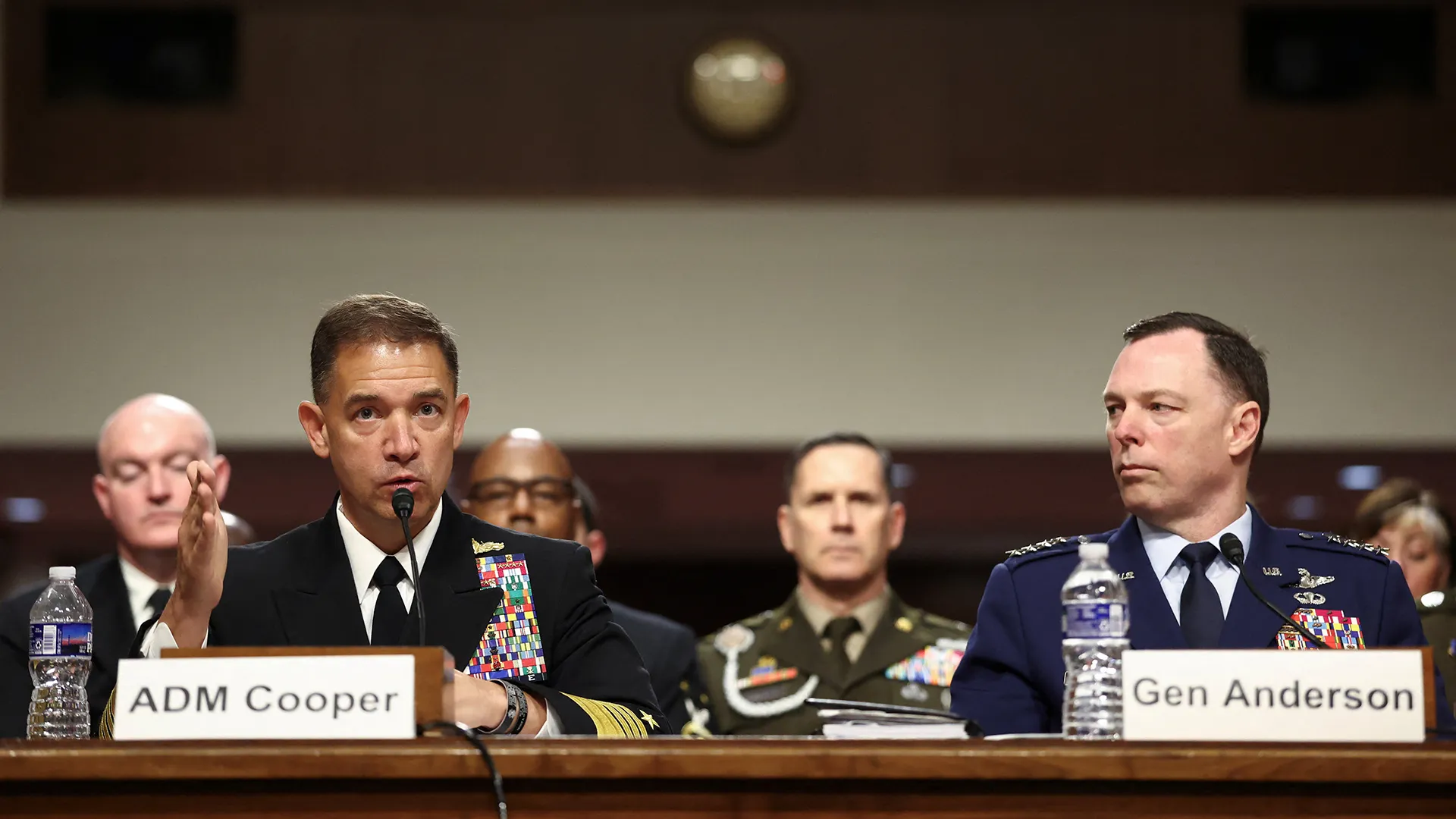
Admiral Brad Cooper, the commander of the U.S. Central Command (CENTCOM), announced that the military operation launched by the United States under the name 'Epic Fury' has resulted in the destruction of about 90% of Iran's military capabilities, making Tehran incapable of executing large-scale attacks or regaining its military status from decades ago.
In a briefing before the U.S. Senate, Cooper confirmed that this operation has led to a 'massive deterioration' in Iranian military capabilities, pointing to a complete collapse in Iran's command and control systems. He described this development as a 'historic turning point' in the regional balance of power.
Details of the Operation
Cooper clarified that Iran has become unable to produce more ballistic missiles and drones, emphasizing that the 'achieved success' has weakened Tehran's ability to extend its military influence beyond its borders, which had posed a direct threat to regional stability and U.S. interests.
He also noted that Iranian-backed factions, such as Hezbollah and Hamas, along with the Ansar Allah group (Houthis), are now 'completely isolated' from Iranian military support and weapon supplies. Cooper mentioned that Iran's proxies have carried out over 350 attacks against U.S. targets, resulting in the deaths of several soldiers and injuries to more than 200 others, asserting that the U.S. response has undermined these capabilities.
Background & Context
These statements come at a time when Iranian activity in the Strait of Hormuz is declining, with Cooper indicating that the number of Iranian fast boats has decreased from 20 or 30 to only 2 or 3 currently. While he described the situation in the strait as 'complex', he affirmed that Tehran's ability to disrupt global trade through this vital corridor has significantly diminished.
Cooper outlined three strategic priorities for CENTCOM at this stage: defending the United States, deterring Iran, and maintaining U.S. power in the face of the Chinese challenge. He confirmed that U.S. forces are implementing the 'Peace Plan' in Gaza approved by former President Donald Trump, noting that the current situation presents an opportunity for a 'historic transformation' in the region.
Impact & Consequences
Despite asserting that the Iranian threat has 'decreased significantly', Cooper warned that Iran remains a significant nation with some capabilities to threaten partners. He called for 'the utmost vigilance' to counter any attempts to undermine ceasefire agreements or escalate tensions.
In conclusion, Cooper emphasized that ensuring U.S. superiority requires constant readiness to act, pointing out that the reality of the region necessitates that U.S. forces be capable of adjusting their deployment in very short timeframes to respond to any emergencies.
Regional Significance
These developments indicate a major shift in the balance of power in the region, potentially affecting the stability of neighboring countries and reshaping regional alliances. The decline of Iranian influence may open the door for other countries to enhance their roles in the area.
Ultimately, the developments in Iran and the Strait of Hormuz remain a focal point of significant interest, as the world closely monitors how these changes will impact regional and international security.