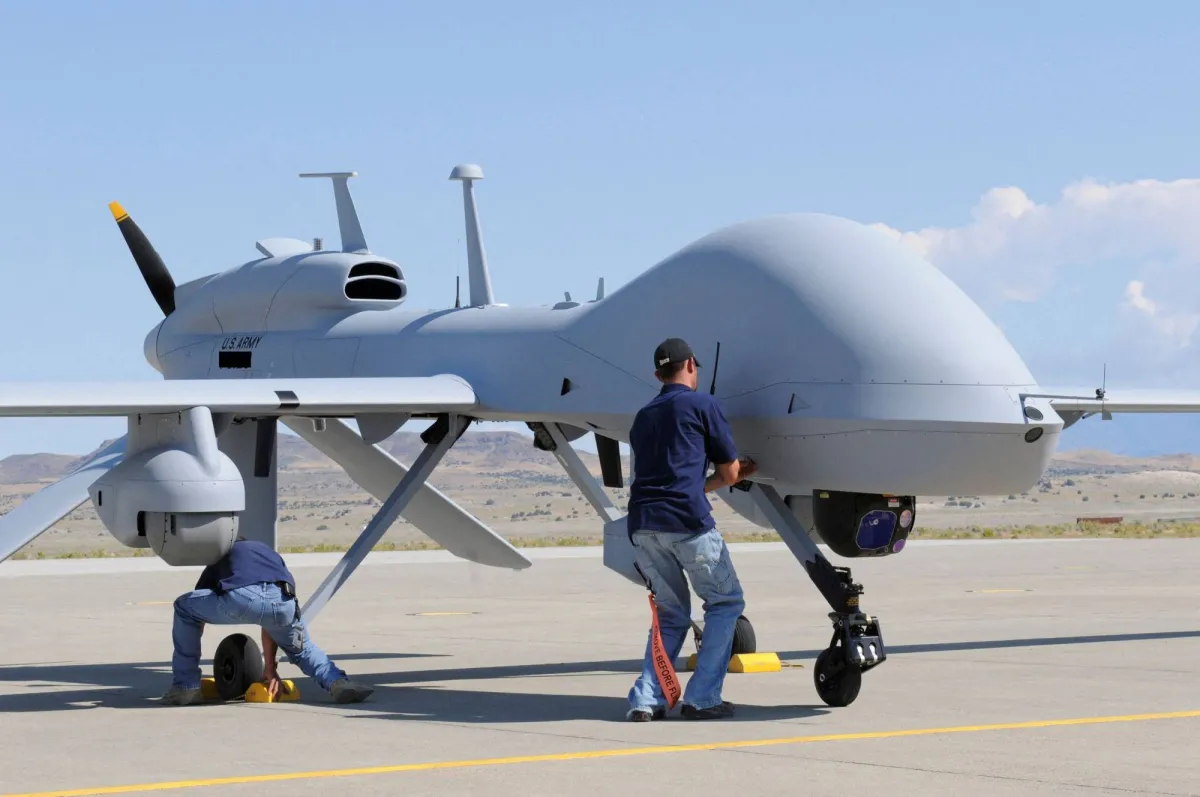
The U.S. military has denied Iranian reports claiming that an American drone was shot down over the Gulf, confirming that all U.S. aircraft have been accounted for and are safe. The U.S. Central Command (CENTCOM) stated via X platform that these allegations are false, emphasizing that no American drone has been downed.
The Iranian reports originated from state television, which alleged that Iranian forces had downed an American drone near the city of Bushehr. However, the U.S. military confirmed that this claim is inaccurate, as the safety of all U.S. air assets has been verified.
Details of the Incident
Earlier, the Tasnim news agency, affiliated with the Iranian Revolutionary Guard, reported that a missile had downed an American drone near Bushehr. Additionally, Fars news agency stated that air defenses in the province fired at an object over the Gulf. In contrast, the U.S. military confirmed that the strike targeting a control center near Bandar Abbas was a response to threats from drones.
It is noteworthy that the U.S. military conducted a strike in an area close to Bandar Abbas, targeting a facility used to operate drones that threaten U.S. and commercial vessels in the Strait of Hormuz. These developments come at a sensitive time as tensions between the United States and Iran escalate.
Background & Context
Tensions in the Gulf region have been rising for some time, with the United States and Iran exchanging accusations regarding military activities. Earlier this week, the region witnessed gunfire exchanges between the two parties, despite ongoing negotiations aimed at de-escalation. These events occur within the framework of complex diplomatic efforts to address nuclear and security issues.
Historically, U.S.-Iranian relations have seen increasing tensions since the Islamic Revolution in 1979. Since then, the region has become a focal point of conflict between major powers, impacting both regional and global security.
Impact & Consequences
These events underscore the significance of the Strait of Hormuz, which is considered a vital transit point for oil and gas. Any escalation in tensions could significantly affect energy prices and global markets. Furthermore, the continuation of tensions may lead to unwanted military escalation, increasing risks to regional security.
Additionally, these events could impact ongoing nuclear negotiations, as the United States seeks to reach an agreement with Iran regarding its nuclear program. Any escalation in hostilities could complicate these negotiations and lead to unforeseen outcomes.
Regional Significance
The Gulf Arab states are directly affected by the tensions between the United States and Iran, as any escalation in military actions could impact security and stability in the region. These events may also lead to increased tensions between Arab states and Iran, complicating regional cooperation efforts.
In conclusion, the situation in the Gulf remains under close observation, with rising concerns about military escalation that could affect regional and global security. It is crucial that diplomatic efforts continue to prevent any unwanted escalation.