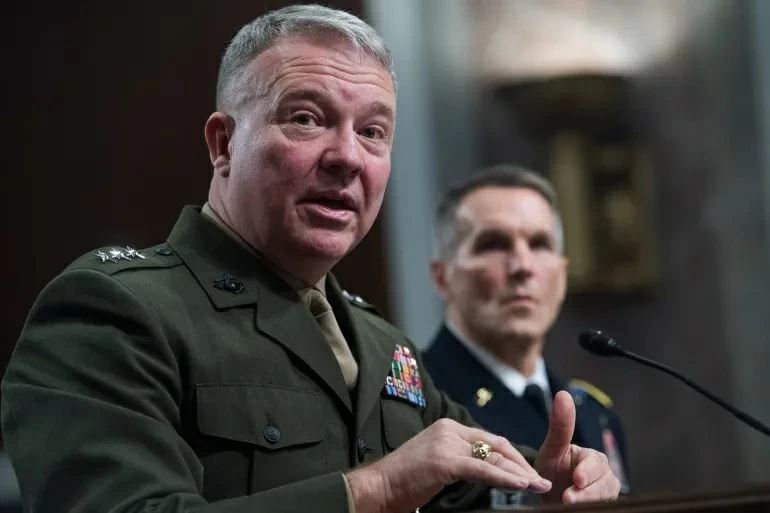
Retired General Frank McKenzie, the former commander of the US Central Command, revealed that the United States has developed detailed military plans over many years to address any escalation in Iran, including scenarios for limited ground intervention and control of strategic sites, primarily the Strait of Hormuz.
In an interview with CBC News, McKenzie stated that the ongoing operations are not random but rather part of a "plan that has been in place for many years," primarily aimed at reducing Iran's capacity to threaten navigation in the Strait of Hormuz.
Details of the Event
McKenzie pointed out that the current phase of the US strategy focuses on establishing permanent air superiority over southern Iran, alongside intensive monitoring and targeting operations against short-range missile sites and drones, which pose the main threat to shipping movements. He explained that these operations aim to weaken Tehran's capabilities to a "very low level," paving the way for more advanced operations that may include incursions to search for potential sea mines in the strait.
He added, "We are not sure if they have already planted mines, but it is expected that they will eventually do so, which aligns with their behavior." Regarding the possibility of using ground forces, McKenzie revealed that US plans have included operational options along the Iranian coast for years, including executing landings to control islands or small bases.
Context and Background
McKenzie confirmed that during his years at Central Command, he oversaw repeated simulations of such scenarios, noting that the current operational performance "is slightly ahead of what was expected" compared to the results of those simulations. He clarified that the US military is not surprised by the potential closure of the Strait of Hormuz, contrary to what political rhetoric may suggest, emphasizing that this scenario has always been part of military calculations, including islands and vital sites along Iran's southern coast.
He cited the example of Khark Island, which is a vital artery for Iranian oil exports, indicating that controlling it could effectively "cripple the entire Iranian oil economy" without the need to destroy infrastructure, allowing it to be used later as a bargaining chip.
Implications and Effects
McKenzie added that such a move would be "extremely humiliating for Iran" and would grant Washington significant leverage in any future negotiations. He emphasized that the primary goal is to ensure that the Strait of Hormuz remains open to international navigation, alongside reaching agreements regarding Iran's missile and nuclear programs.
From a military perspective, achieving these objectives represents the "maximum that can be attained," noting that these outcomes are still "within reach," but they require continued military pressure on Iran.
Impact on the Arab Region
Concerns are rising in the region over escalating tensions between the United States and Iran, as any military operations could destabilize Gulf Arab states. Additionally, controlling the Strait of Hormuz, which is a vital artery for global oil trade, could significantly impact oil prices and energy markets.
Under these circumstances, Arab countries must be prepared to face any potential repercussions, whether economic or political, resulting from these military developments.