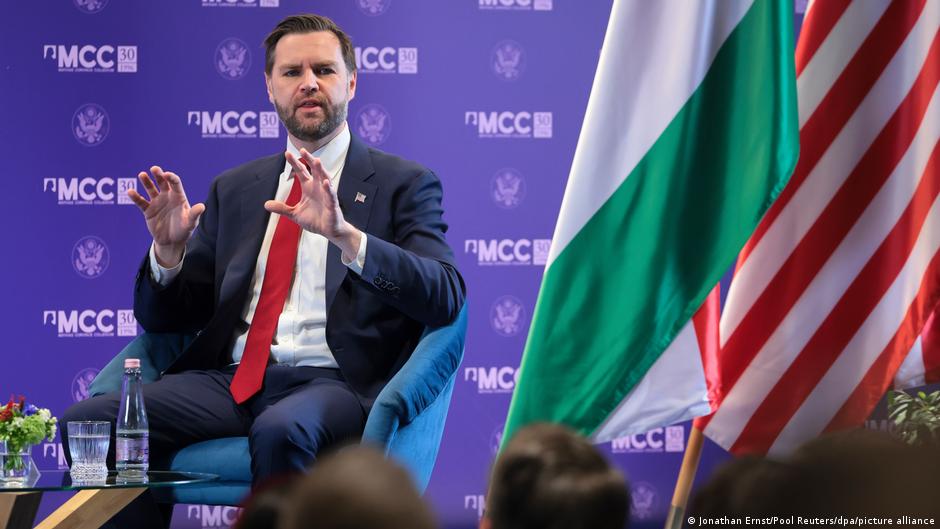
During his visit to Hungary, US Vice President JD Vance criticized European Union leaders and Ukrainian President Volodymyr Zelensky, as part of his support for Hungarian Prime Minister Viktor Orban ahead of the upcoming elections. These statements come at a critical juncture, as Orban seeks to secure a sixth term amid strong competition from his right-wing opponent Péter Márki-Zay.
On the second day of his visit, Vance noted that the Trump administration had made significant progress in mediating a halt to the Russian invasion of Ukraine, but he acknowledged that this war has been the most difficult to resolve. He explained that the challenges faced by European countries in dealing with this conflict reflect their lack of genuine interest in resolving the dispute.
Details of the Event
Vance criticized European leaders while praising Orban, who is seen as one of the European leaders who maintained close ties with Moscow during the war. He expressed disappointment at the European leaders' lack of interest in resolving the conflict, stating that the war no longer makes sense. He raised questions about the feasibility of continuing to fight over small territories, given the significant human and economic losses.
Vance's visit comes at a time when Hungary is experiencing tensions with Ukraine due to rising fuel prices and the halt of Russian oil supplies through Ukraine. Zelensky has accused Orban of obstructing a large loan package for Ukraine, which has heightened tensions between the two countries.
Background & Context
Historically, under Orban's leadership, Hungary has adopted a foreign policy distinct from other EU countries, seeking to maintain good relations with Russia, which has drawn criticism from some European nations. Orban, who has been Prime Minister since 2010, faces internal challenges related to corruption and scandals involving mismanagement of government institutions.
This election coincides with growing concerns about the impact of the Ukrainian conflict on the Hungarian economy, which heavily relies on Russian energy. The sanctions imposed on Russia have increased economic pressures on the country, making domestic issues more prominent in the electoral campaign.
Impact & Consequences
Vance's remarks are part of a broader strategy to strengthen American relations with European countries that share similar positions to Orban. This new alliance between the United States and Hungary reflects a shift in American foreign policy towards Eastern Europe, as Washington seeks to enhance its influence in the face of Russia.
Furthermore, Vance's criticisms of Zelensky may affect relations between the United States and Ukraine, especially given the ongoing need for American support for Ukraine in the face of the Russian invasion. These dynamics could lead to a reassessment of political strategies in the region.
Regional Significance
The events in Hungary have direct implications for the Arab region, as the relationships between European countries and Russia affect global energy prices, which in turn impact Arab economies reliant on oil exports. Additionally, political tensions in Europe may influence regional stability in the Middle East.
In conclusion, it is evident that political conflicts in Europe are not far removed from global influences, and new alliances may reshape the political landscape in the region.