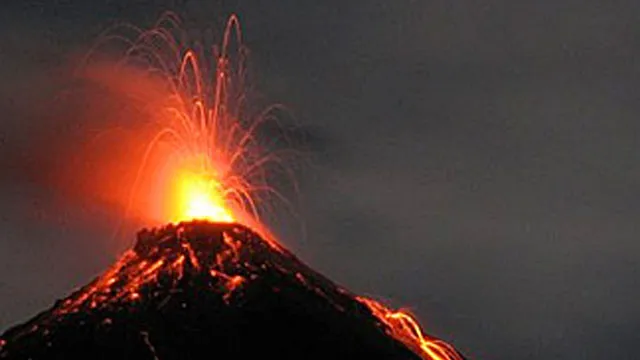
The Karangetang volcano in Kepulauan Sitaro, Indonesia, exhibited significant volcanic activity on Wednesday morning, releasing lava accompanied by loud rumbling sounds. Reports from the Geological Agency of Indonesia's Ministry of Energy and Mineral Resources indicated that the volcanic activity requires close monitoring due to the risk posed to local residents.
According to statements from Lana Saria, the acting head of the Geological Agency, visual monitoring showed white smoke rising from the volcano's summit, with varying densities of smoke ranging from light to heavy. Dense white smoke was observed on the right side of the summit, while the left side exhibited intermittent white smoke.
Details of the Eruption
Lana further explained that the lava flow was notably observed from the left summit (the second crater), where the lava collided with the main crater wall. This activity resulted in clouds of white smoke extending over the body of the volcano, due to the flow of volcanic materials down the slopes.
Despite the lava flow, the Geological Agency confirmed that the end of the lava flow is approximately 1200 meters from the summit, and there are no visible signs of significant activity in that area at this time. The agency continues to monitor seismic activity and surface changes to anticipate any potential threats to residents near the volcano.
Background & Context
The Karangetang volcano is one of the active volcanoes in Indonesia, known for its numerous active volcanoes due to its location on the Pacific Ring of Fire. Historically, the volcano has experienced several eruptions, making it a subject of research and study by scientists and geologists.
Indonesia is characterized by frequent volcanic and seismic activity, as it lies at the intersection of several tectonic plates. Therefore, any volcanic activity in the region warrants significant attention from local authorities and the scientific community.
Impact & Consequences
Volcanic activities such as those witnessed at the Karangetang volcano can have significant effects on the surrounding environment, including lava flows, explosions, and the formation of volcanic clouds that may impact air quality. There is also a risk to the lives of local residents, necessitating precautionary measures.
Authorities are working to educate residents and tourists about the importance of adhering to safety guidelines, including staying away from hazardous areas. Safe zones have been identified to avoid any potential incidents.
Regional Significance
Despite the distance between Indonesia and the Arab world, natural events such as volcanic eruptions attract global interest. Climate changes and volcanic activity can affect weather patterns in distant regions, including Arab countries. There is also a growing interest among Arab scientists in studying natural phenomena in various parts of the world.
In conclusion, monitoring volcanic activity in Indonesia remains vital, as local authorities and the international community must prepare for any potential repercussions that may arise from these natural phenomena.