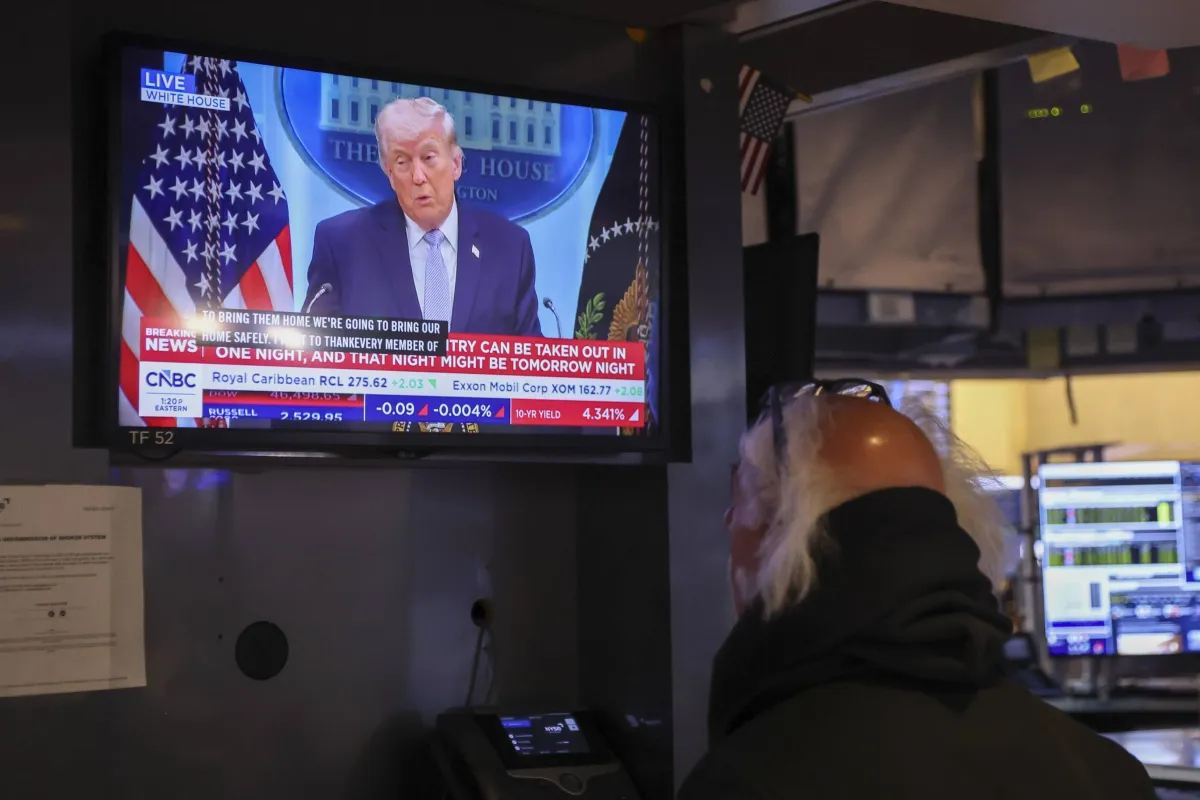
Wall Street stocks declined at the start of trading on Tuesday, as financial markets experienced a wave of anxiety due to U.S. President Donald Trump's escalating threats against Iran. This occurred at a time when oil prices rose, reflecting growing fears of heightened tensions in the region.
Trump warned via social media that "an entire civilization will be affected" if Iran does not comply with U.S. demands. He asserted that he would destroy Iranian civilian infrastructure, including bridges and power plants, if the Strait of Hormuz is not reopened to oil tanker traffic.
Details of the Event
Following a day of stock gains, the Dow Jones Industrial Average fell by 0.7% to 46,368.33 points. The S&P 500 index also dropped by 0.5% to 6,576.59 points, while the Nasdaq Composite decreased by 0.6% to 21,859.32 points.
David Waddell, Chief Investment Strategist at Waddell & Associates, believes that the markets are treating Trump's statements as a negotiating tactic, having learned not to overreact to his threats.
Background & Context
These developments come amid increasing tensions in the region since the confrontation between the United States and Israel on one side and Iran on the other began in late February. This has led to Iran closing the Strait of Hormuz, considered one of the most vital corridors for global oil supplies, raising concerns about rising inflation rates worldwide.
Investors had hoped for successful diplomatic efforts to contain the escalation, but negotiations have yet to yield significant progress. Moreover, Iran has not responded to Trump's deadline, which ends on Tuesday evening, further intensifying tensions.
Impact & Consequences
Gulf stock markets fell at the close of trading on Tuesday, with the general index of the Saudi market declining by 1.6%, affected by a 2% drop in Al Rajhi Bank shares and a 2.5% decrease in SABIC shares. Meanwhile, Aramco's shares rose by 0.1%.
The Dubai Financial Market Index also fell by 0.8%, impacted by a 3.9% decline in Emaar Properties shares, while the Abu Dhabi index decreased by 0.3%. In Qatar, the index closed down by 0.6%, pressured by a 1.6% drop in Qatar National Bank shares.
Regional Significance
In Egypt, the main stock index fell by 2%, influenced by a 4.5% drop in Commercial International Bank shares, as the stock traded without distribution rights. These developments reflect a state of concern among investors in the region, as the economy is directly affected by geopolitical tensions.
In closing remarks, Russian Prime Minister Mikhail Mishustin stated that disruptions in global supply chains due to the war in the Middle East could open new business opportunities for Russia, emphasizing the importance of price stability in the domestic market.