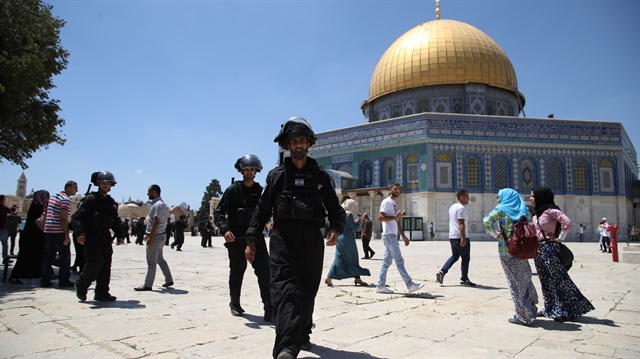
The Popular Conference for Palestinians Abroad has issued an urgent call to warn against the dangers of the ongoing Israeli occupation's closure of Al-Aqsa Mosque, which started in mid-Ramadan. This is the first time the mosque has been closed for such an extended period since the occupation of Jerusalem in 1967.
In statements made by the head of the Jerusalem Committee in the conference, Helmi Al-Balbisi, he emphasized that the "Call of Al-Aqsa" comes amid the continued closure of the mosque and the prevention of worshippers from entering, which represents a dangerous step within a systematic Israeli policy aimed at imposing a new reality in the city of Jerusalem.
Details of the Event
Al-Balbisi stated that what is happening in Jerusalem is not merely a security measure as the occupation authorities claim, but rather a gradual attempt to impose complete control over Al-Aqsa Mosque by restricting worshippers and disrupting their rituals. He explained that the occupation authorities justify these measures under the pretext of a state of emergency related to the US-Israeli war on Iran; however, these justifications do not conceal the reality of policies aimed at imposing strict restrictions on Al-Aqsa and reducing its Islamic presence.
Moreover, Al-Balbisi stressed that these measures constitute a blatant violation of the freedom of worship and a direct interference in the historical role of Islamic endowments in overseeing and managing Al-Aqsa Mosque. He called on the Palestinian people, the Arab and Islamic nations, and all free people of the world to reject the Israeli violations against Al-Aqsa Mosque and to demonstrate to create a state of international and Islamic pressure on the occupation government to open the mosque and halt the policy of Judaization.
Context and Background
The "Call of Al-Aqsa" comes at a critical stage threatening the mosque, as the occupation exploits the international situation to implement its Judaization policies against Islamic and Christian sanctities in Palestine. Since February 28, the Israeli occupation has continued to close Al-Aqsa Mosque and prevent worshippers from accessing it, under the pretext of tensions in the region.
This year, the occupation authorities also prevented the Taraweeh prayers and the Eid al-Fitr prayers at Al-Aqsa Mosque for the first time since the occupation of East Jerusalem in 1967, reflecting a noticeable escalation in Israeli measures against the sanctities.
Impact and Consequences
These measures are considered a serious escalation that threatens the Islamic identity of Jerusalem and reflect the occupation's intention to change the demographic and religious reality in the city. The continued closure of Al-Aqsa Mosque reflects a systematic policy aimed at weakening the Palestinian presence in Jerusalem, which could lead to an explosion of tensions in the region.
Furthermore, these policies may provoke strong reactions from Palestinians, Arabs, and Muslims, potentially increasing tensions in the region and affecting international relations. The international community's disregard for these violations may bolster the occupation's policies and complicate the situation in Jerusalem.
Impact on the Arab Region
The closure of Al-Aqsa Mosque represents a significant challenge for the Arab and Islamic nations, as Al-Aqsa is a symbol of sanctity and Islamic identity. Any harm to this sacred place could lead to widespread popular movements in the Arab world and may contribute to strengthening unity among Arab and Islamic peoples in the face of occupation.
In conclusion, the situation in Jerusalem and the Islamic sanctities requires concerted efforts from Arab and Islamic countries, in addition to the international community, to pressure the Israeli occupation to stop its violations and open Al-Aqsa Mosque to worshippers. Protecting Al-Aqsa is a collective responsibility that requires activating all available means to pressure the occupation.