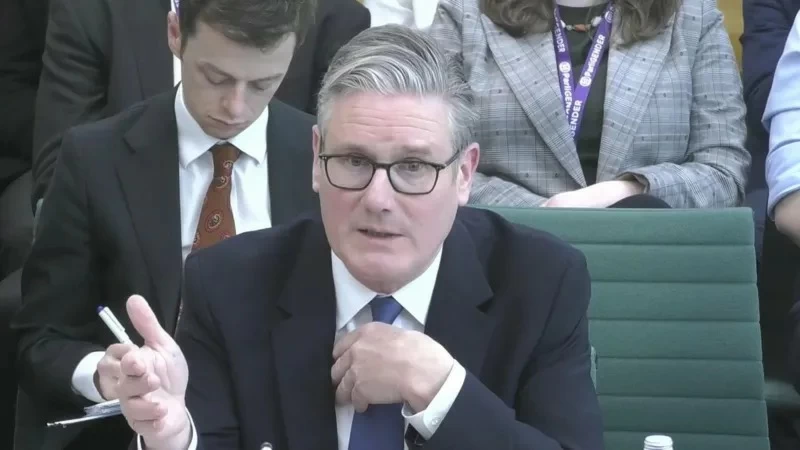
UK Prime Minister Keir Starmer has warned that the ongoing war with Iran may not conclude anytime soon, directing his government team to avoid falling into assumptions of a quick resolution to the conflict.
During a session before the parliamentary liaison committee, Starmer stressed the urgent need to work towards de-escalation while simultaneously indicating that the government must prepare for the possibility of a prolonged conflict.
Details of the Current Situation
Starmer confirmed that the current conflict is "not Britain's war," emphasizing that any potential involvement must be based on a clear legal foundation and a carefully considered plan. His remarks followed former President Donald Trump's announcement that discussions between Washington and Tehran were very strong, and there was a serious chance of reaching an agreement to end hostilities, despite Iran denying any negotiations.
In this context, Starmer acknowledged the pressures being exerted on him, referencing Trump's criticisms of London for refusing to allow the use of its military bases for initial strikes, asserting that he would not back down from making decisions that serve British national interests.
Background & Context
Starmer revealed that an emergency meeting of the government’s emergency committee (Cobra) was held, involving senior ministers and the Governor of the Bank of England, to discuss the economic impacts of the war, particularly following the rise in energy prices. Iran had responded to the US-Israeli strikes by disrupting shipping in the Strait of Hormuz, leading to a global increase in oil and gas prices.
The Prime Minister noted that the government is considering providing support for families as the current energy price cap comes to an end, especially with expectations of increased consumption in the coming months. He indicated that Chancellor Rachel Reeves would deliver an official statement to Parliament regarding the outcomes of the meeting. He also hinted at the possibility of taking measures to counter corporate exploitation of the crisis, including enhancing the powers of the Competition and Markets Authority to curb price manipulation.
Impact & Consequences
Domestically, Conservative Party leader Kemi Badenoch called for increased oil production in the North Sea and a reduction in fuel taxes, while Zak Polanski, leader of the Green Party in England and Wales, demanded higher taxes on energy companies and increased investment in renewable energy sources.
Starmer confirmed that Britain has not participated in military strikes but has allowed the use of its bases to support US operations, stressing that his country would not be drawn into war. In a military context, Defense Secretary John Healy announced that two Iranian missiles were launched towards the Diego Garcia base shared by Britain and the United States, but they did not reach their target and posed no direct threat.
Regional Significance
The British destroyer HMS Dragon has also arrived in the eastern Mediterranean, beginning defensive coordination operations with allies. The parliamentary session witnessed tension, with several MPs criticizing the slow deployment of British forces, deeming the military response insufficient.
Starmer responded to these criticisms by pointing out that years of underinvestment in defense during previous governments have affected the readiness of the armed forces, asserting that a new defense investment plan is currently being prepared. The British government's statements reflect a cautious approach to dealing with the war, balancing efforts to de-escalate while preparing for long-term scenarios, all while attempting to mitigate economic and political repercussions domestically without direct involvement in the conflict.