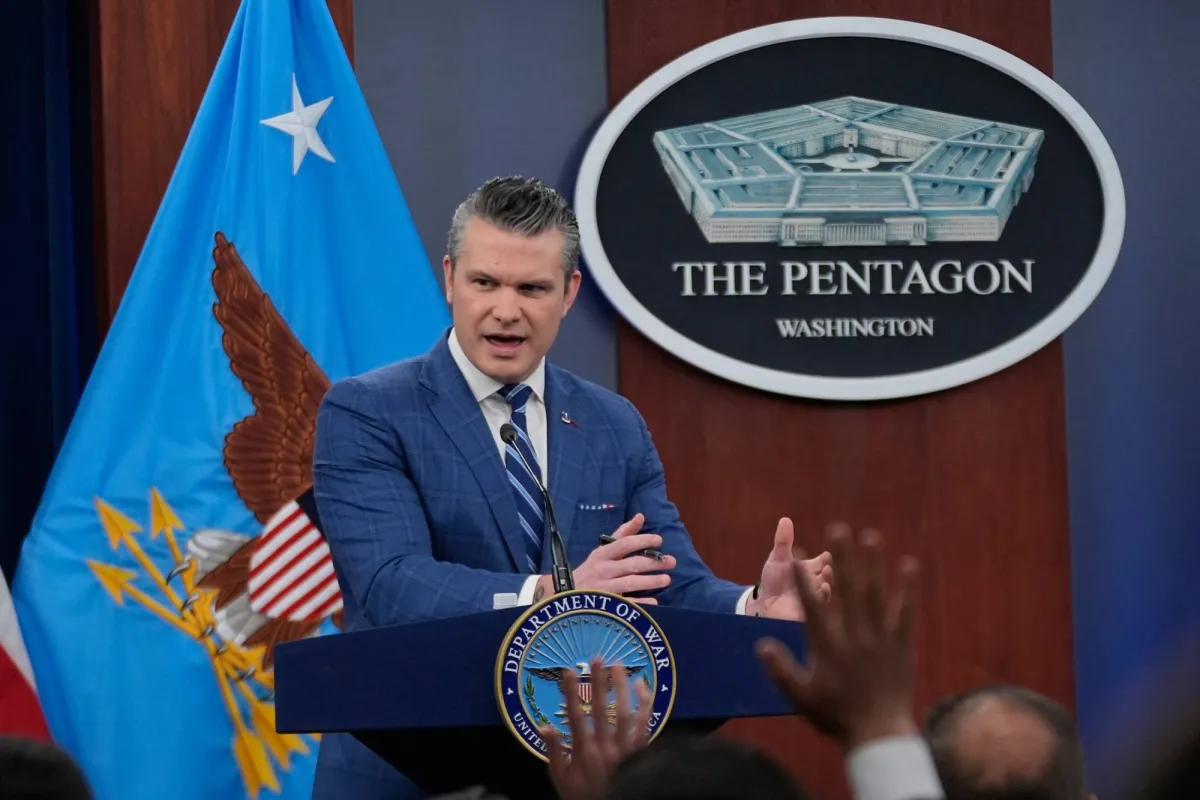
During a press conference held on the morning of Wednesday, April 8, 2026, U.S. Defense Secretary Pete Hegseth and Chairman of the Joint Chiefs of Staff Dan Cain confirmed that the United States has achieved its military objectives in Iran, stating that the "Epic Fury Operation" has significantly destroyed Iran's military capabilities.
Hegseth explained that Iran is no longer able to produce missiles or drones, as its factories have been destroyed. He noted that this operation represents a historic victory for the United States, having severely weakened Iranian forces, rendering them incapable of fighting for years to come.
Details of the Operation
During the conference, Hegseth warned that the United States is ready to seize Iranian uranium if Tehran refuses to deliver it, emphasizing that Washington is aware of Iran's nuclear stockpile. Cain added that military operations targeted approximately 90% of Iran's weapon factories, including all facilities producing explosive drones.
Regarding the Iranian naval fleet, Cain clarified that rebuilding combat facilities will take years, reflecting the extent of damage inflicted on Iranian naval forces. He also confirmed that around 80% of Iran's nuclear industrial base has been targeted, hindering efforts to develop nuclear weapons.
Background & Context
These statements come at a sensitive time, as the conflict between the United States and Iran continues despite a declared ceasefire. Experts have indicated that this truce is merely a temporary freeze of hostilities, with core issues such as uranium enrichment and the Strait of Hormuz still open for discussion.
Reports have also shown that Iran is attempting to establish a new equation in the region, requiring permission for ships to pass through the Strait of Hormuz, indicating its aim to enhance its supervisory role in regional waters.
Impact & Consequences
Statements from Pentagon leaders suggest that the conflict is not yet resolved, and the United States is prepared to resume military operations if necessary. This could lead to a new escalation in the region, increasing tensions between the United States and Iran.
Moreover, the ongoing Israeli military operations against Hezbollah in Lebanon, despite the ceasefire with Iran, reflect the complexity of the security situation in the region, where proxy battlefields remain open for conflict.
Regional Significance
These developments directly impact security and stability in the Arab region, as any new escalation could have negative repercussions for neighboring countries, especially with other regional powers seeking to enhance their influence in the area.
In conclusion, it appears that the region is entering a period of tactical calm, dependent on the outcomes of upcoming negotiations in Islamabad and the commitment of both sides to ceasefire terms.