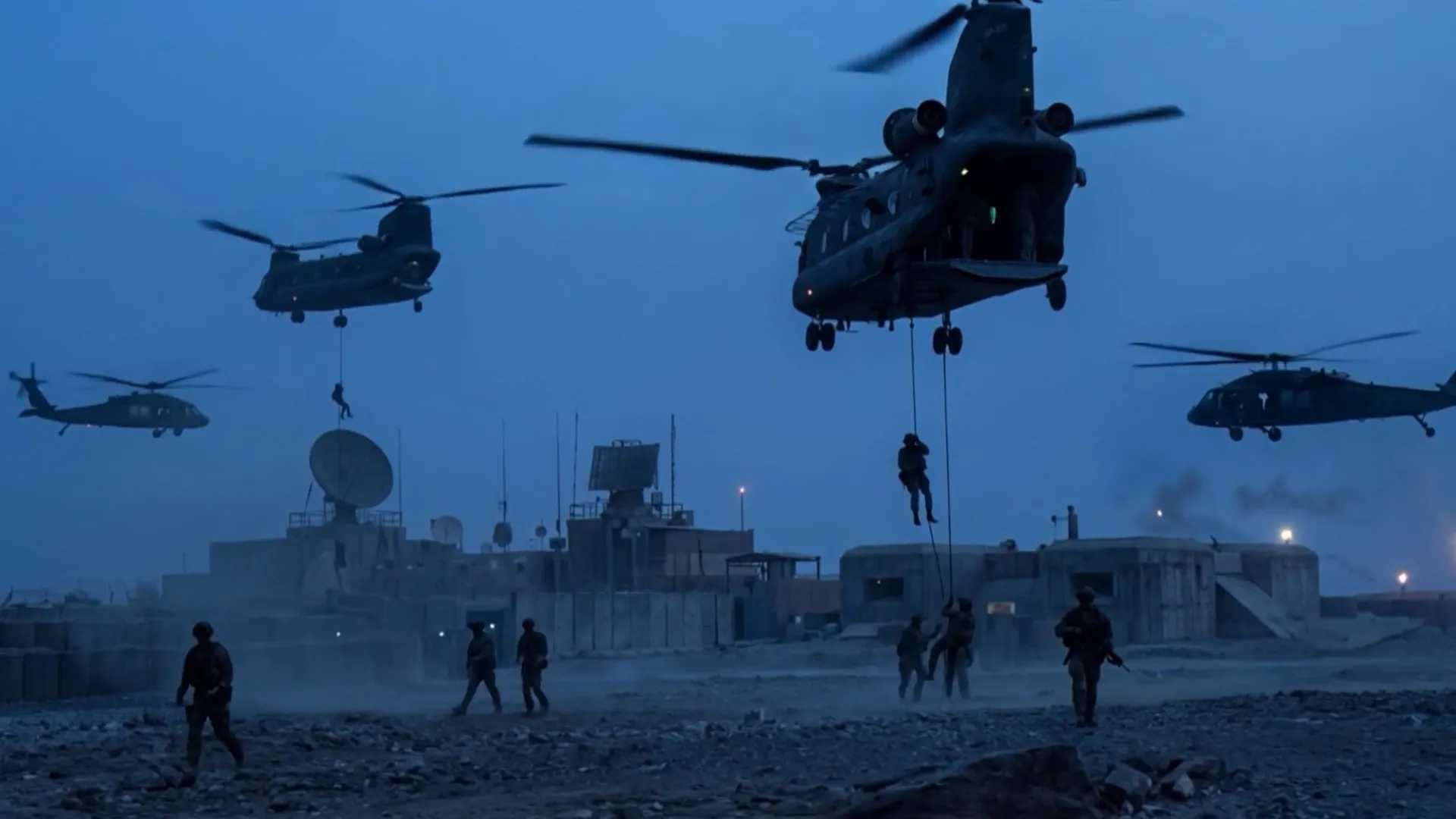
The focus is shifting towards the limited ground operations being considered by the United States inside Iran, in light of escalating regional tensions and an increase in U.S. military buildup. These options are part of an expanded strategy to address security challenges and may include rapid deployments and targeted incursions; however, they face significant complexities regarding potential Iranian responses.
According to a report prepared by Ahmed Jarrar, this option is not viewed as a full-scale invasion but rather as a limited operational pathway that Washington may adopt if confrontations escalate. These operations rely on the capabilities of U.S. special forces, along with naval and aerial deployments, providing tactical flexibility in managing operations.
Details of the Event
U.S. reports, including those published by the Washington Post, indicate that the U.S. Department of Defense is preparing for weeks of ground operations inside Iran, awaiting a political decision that would allow for this scenario to be executed. These operations are expected to focus on achieving specific tactical gains without slipping into a prolonged war of attrition.
The U.S. forces are equipped with a diverse arsenal that includes assault rifles, sniper weapons, and guided anti-tank missiles, in addition to utilizing drones for reconnaissance and precision targeting. These forces will also receive air support from helicopters and fighter jets, enhancing their ability to penetrate defenses and reach targets with minimal casualties.
Background & Context
These movements coincide with a heavy naval presence, with the aircraft carrier USS Abraham Lincoln positioned at the heart of the operational theater, while the USS George W. Bush heads towards the Arabian Sea, supported by the amphibious ship USS Boxer. These naval vessels provide advanced platforms for launching operations, whether through direct landings on shores or supporting ground forces.
Potential targets for these operations include conducting precise strikes on sensitive military sites and destroying capabilities deemed a threat to international navigation, particularly around the Strait of Hormuz. They also aim to control Iran's stockpile of highly enriched uranium, estimated at around 440 kilograms, and seize strategic points such as Kharq Island, a center for Iranian oil storage and export.
Impact & Consequences
However, these scenarios face significant field complexities, the most notable being the nature of potential Iranian responses. Tehran possesses an advanced missile arsenal and fleets of drones, enabling it to disrupt any ground advance. Additionally, the Iranian Revolutionary Guard has the capability to operate in a complex geographical environment, employing hybrid tactics that combine direct confrontation with long-term attrition operations.
Tehran may lean towards avoiding direct conventional engagement, preferring to prolong the confrontation through sporadic strikes targeting supply lines and advancing forces, thereby increasing the cost of any ground operation and heightening its risks. With U.S. forces positioned within Iranian territory, these troops will remain vulnerable to a constant threat, imposing additional challenges related to their security and protection.
Regional Significance
The options for ground operations remain tied to precise intelligence assessments of the outcomes of U.S. and Israeli airstrikes, and their effectiveness in weakening Iranian defensive structures. The decision is also linked to broader calculations that include regional reactions and the potential for the confrontation to expand into other arenas, such as Bab el-Mandeb, which could turn any ground intervention into a spark for a wider regional conflict.
In conclusion, the options for ground operations within Iran are complex and require careful consideration of the potential consequences, both militarily and politically, in a tense regional environment.