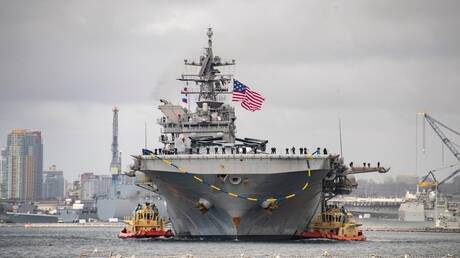
The United States has announced the deployment of a third aircraft carrier to the Middle East, a move that reflects the escalating tensions between Washington and Tehran. This announcement was made by U.S. Secretary of Defense Pete Hegseth, who emphasized that the coming days will be "crucial" in the ongoing conflict with Iran.
These developments come at a sensitive time, as relations between the United States and Iran are increasingly strained, particularly following a series of events that have heightened the conflict. The deployment of the aircraft carrier underscores the U.S. commitment to protecting its interests in the region and signals its readiness to confront any potential threats from the Iranian side.
Details of the Deployment
The newly deployed aircraft carrier is part of a broader set of military reinforcements that also includes fighter jets and warships. These reinforcements are in line with the U.S. strategy to enhance its military presence in the region, especially following attacks targeting American interests in Iraq and Syria.
Moreover, the U.S. military movements come at a critical juncture, with growing concerns that Iran may escalate its military activities in the region, potentially leading to a larger conflict. The U.S. Secretary of Defense indicated that these steps aim to deter any hostile actions by Iran and ensure the safety of American forces and interests in the area.
Background & Context
Historically, U.S.-Iranian relations have been marked by increasing tensions since the Iranian Revolution in 1979. Since then, the United States has imposed strict economic sanctions on Iran, exacerbating the situation. In recent years, these tensions have significantly escalated, particularly after the U.S. withdrawal from the Iranian nuclear agreement in 2018.
Several factors have contributed to the escalation of tensions, including Iran's support for armed groups in the region, the development of its nuclear program, and attacks targeting commercial vessels in the Arabian Gulf. These combined factors make it difficult to reach a peaceful resolution to the ongoing conflict.
Impact & Consequences
The deployment of the third aircraft carrier to the Middle East could have significant implications for the security situation in the region. This escalation is likely to increase tensions between Iran and Gulf states and may contribute to a military conflict in the event of any direct confrontation.
Additionally, this move could impact global oil prices, as any escalation in the region may raise fears of oil supply disruptions. This could negatively affect the global economy and increase pressure on financial markets.
Regional Significance
Neighboring Arab countries such as Iraq, Saudi Arabia, and the UAE find themselves in a sensitive position due to these developments. These countries may feel compelled to adopt cautious stances amid military escalation, which could affect their internal stability.
Any escalation in the conflict between the United States and Iran could have negative repercussions for regional security and may contribute to an increase in armed conflicts in the area. Furthermore, these developments could impact peace efforts in other conflict zones, such as Syria and Yemen.
In conclusion, the U.S. military escalation in the Middle East appears to be a strategic move aimed at deterring Iran, but it may lead to worsening conditions and increased tensions in the region. Hope remains pinned on diplomacy as a means to avoid further escalation.