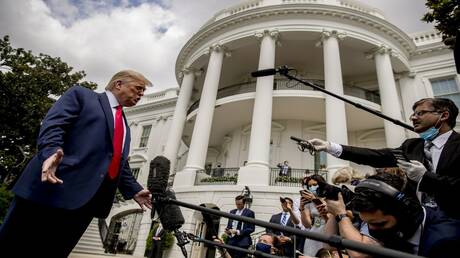
The White House announced on Saturday evening a ban on photographing and covering President Donald Trump's departure from the White House, a move that has sparked questions regarding the reasons behind this decision. According to RT's correspondent in Washington, accredited reporters and photographers received an official notification regarding this matter, raising concerns about media transparency under the Trump administration.
This step comes at a time when the White House is facing numerous political challenges, including ongoing investigations into Trump's behavior and that of his administration. Many observers have considered this decision to be an attempt to reduce negative media coverage that could impact the president's image ahead of his potential departure.
Details of the Event
In the details of the event, reporters noted that the White House did not provide a clear explanation for the reasons behind the photography ban, which adds to the ambiguity surrounding the decision. Journalists have been accustomed to covering the president's departures, as these moments represented an opportunity for interaction with the public and for conveying direct messages from the president.
This ban comes at a sensitive time, as Trump faces increasing pressure from the media and the political community. Some have viewed this decision as part of a broader strategy to limit media coverage that could negatively affect the administration's image.
Background & Context
Historically, the White House has been considered a center for media transparency, where coverage of the president's departure was part of American democratic traditions. However, recent years have seen a decline in this transparency, as the current administration has taken multiple steps to limit journalists' access to information.
It is worth noting that Trump has faced numerous criticisms regarding his approach to the media, with some accusing him of seeking to undermine press freedom. With this new ban, it appears that these trends continue, raising concerns about the future of media coverage in the United States.
Impact & Consequences
This decision could have significant implications for the relationship between the White House and the media. With increasing restrictions, journalists may feel unable to perform their duties effectively, which could impact the quality of news coverage.
Additionally, this decision could lead to increased doubts about government transparency, which may affect public trust in government institutions. Under these circumstances, Trump may find himself in a difficult position, as he must deal with the repercussions of this decision on his public image.
Regional Significance
In the Arab context, this decision may be seen as an indicator of how governments handle the media. Many Arab countries suffer from restrictions on press freedom, and this decision could be viewed as a warning that such policies may spread to other regions.
The decline in transparency in the United States could also impact international relations, as many Arab countries rely on information from American media to understand foreign policies. Therefore, this decision may have far-reaching effects on the region.
In conclusion, the White House's decision to ban photography of Trump's departure highlights the ongoing challenges facing press freedom in the United States. As restrictions increase, the question remains about how this will affect American democracy and international relations.