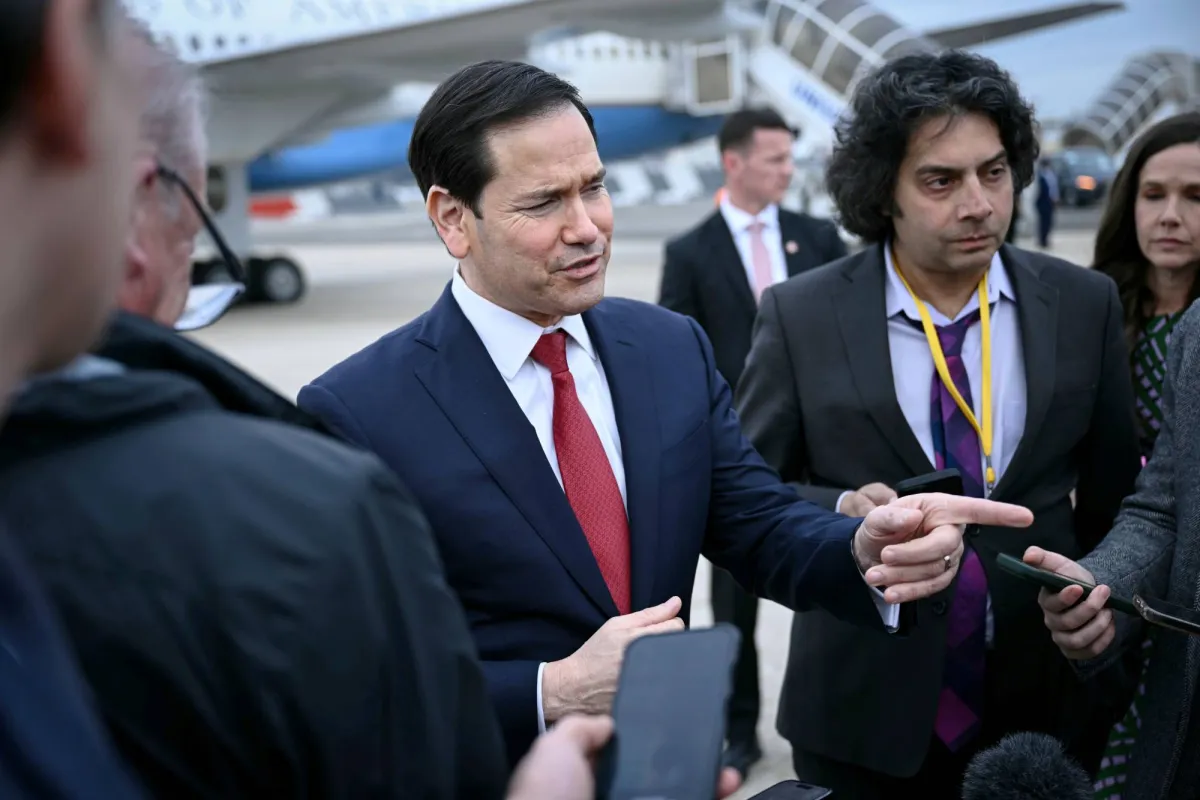
U.S. Secretary of State Marco Rubio accused Ukrainian President Volodymyr Zelensky of lying after the latter claimed that Washington was pressuring Kyiv to cede key territories in exchange for security guarantees for Ukraine. Rubio asserted that these statements are false, emphasizing that security guarantees would only come into effect after the war ends.
Speaking to reporters following G7 talks near Paris, Rubio described Zelensky's remarks as "lies," adding that Zelensky knows they are untrue. He noted that the United States has not conditioned Ukraine to make concessions in the eastern Donbas region, as Zelensky claimed.
Details of the Event
Rubio stated that the United States has not redirected any weapon shipments designated for Ukraine so far, but he did not rule out that possibility in the future. He explained that any U.S. needs in the war against Iran might lead to the reallocation of some arms. These statements come at a time when pressures on U.S. military stockpiles are increasing due to multiple conflicts.
Media reports indicated that discussions within the U.S. Department of Defense include air defense missiles that were intended for Ukraine, raising concerns about Kyiv's ability to withstand Russian pressures. The United States has used over 850 Tomahawk missiles against Iran, reflecting the urgent need to bolster defensive capabilities.
Background & Context
The roots of the Ukrainian crisis trace back to 2014, when Ukrainian President Viktor Yanukovych was ousted, leading to heightened tensions between Russia and Ukraine. Since then, relations between the West and Russia have significantly deteriorated, with Russia continuing to support separatists in eastern Ukraine.
In 2022, Russian forces invaded Ukrainian territory, leading to an ongoing war. Under these circumstances, Ukraine is seeking continuous military support from the West, while pressures on the United States to meet its military needs are increasing.
Impact & Consequences
Rubio and Zelensky's statements reveal divisions within the Western alliance regarding how to support Ukraine. While Kyiv seeks more assistance, there are concerns that other conflicts, such as the war against Iran, may affect the United States' ability to meet Ukraine's needs.
Warnings about a decline in support for Ukraine could bolster Russia's position, which hopes that escalation in the Middle East will divert attention from its actions in Ukraine. In this context, the German Foreign Minister warned that any concessions regarding Ukrainian defense would benefit Russia.
Regional Significance
The Arab region is indirectly affected by these developments, as military conflicts in Ukraine and Iran may lead to changes in military and defense policies in the area. Increasing tensions between major powers could impact regional stability and complicate security situations.
Ultimately, the situation in Ukraine remains a focal point of global interest, as major countries strive to balance their security and political interests, making it difficult to predict the course of events in the future.