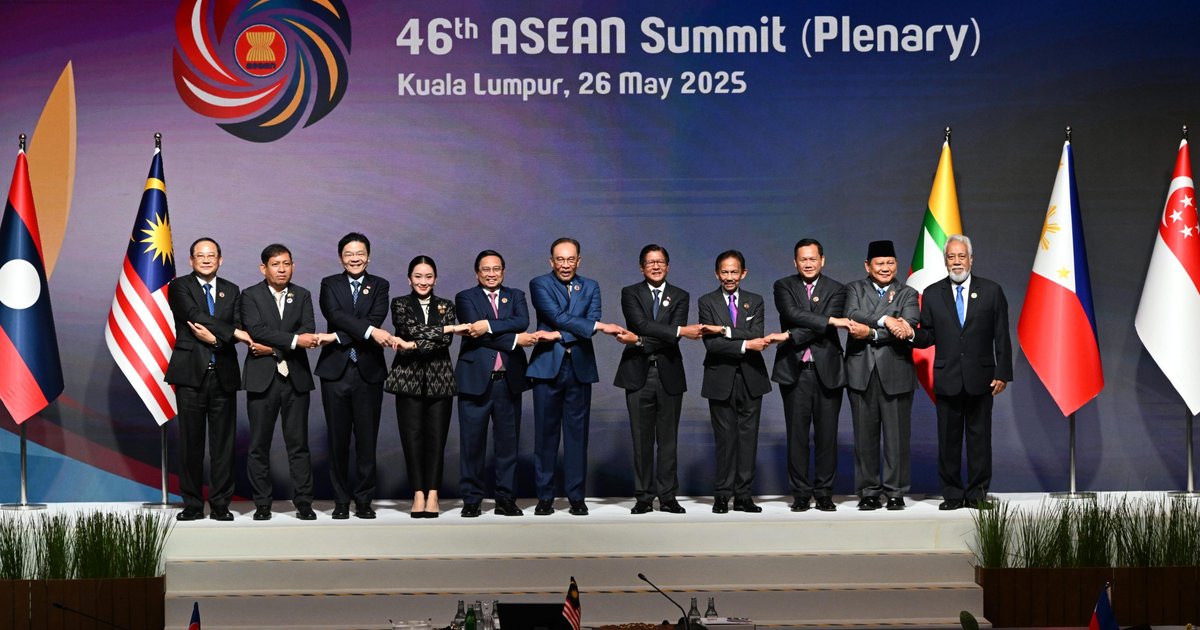
Singapore's Prime Minister, Lawrence Wong, confirmed that ASEAN countries are adopting a unified position of neutrality in the ongoing conflict between China and the United States. This statement was made during an interview with Singaporean media following his four-day visit to China.
Wong noted that "Singapore's approach to open and inclusive engagement with major powers is not unique; it is also ASEAN's stance." He explained that all ASEAN nations prefer not to take sides, emphasizing that ASEAN's position is to actively engage with all major powers to build an open and inclusive region.
Event Details
During his remarks, Wong pointed out that ASEAN summits already bring together a wide range of partners, including Australia and New Zealand, as well as China, Japan, and South Korea through the ASEAN Plus Three platform. He stressed the importance of engaging in positive and constructive dialogue with all major powers, even amid the challenges faced.
He also highlighted the difference between Singapore and the two locations he visited in China, namely Hong Kong and Hainan, clarifying that Singapore lacks a large hinterland, while ASEAN can play that role. He called for intensified efforts to integrate the broader ASEAN market, pointing out the significance of sub-regional arrangements such as the proposed growth triangle linking Singapore, Johor in Malaysia, and the Riau Islands in Indonesia.
Background & Context
The Association of Southeast Asian Nations (ASEAN) was established in 1967 and currently comprises ten countries. The association aims to enhance economic, political, and security cooperation among its members and serves as an important platform for interaction with major powers in the region. Amid increasing tensions between the United States and China, ASEAN seeks to maintain its independence and promote regional cooperation.
Historically, ASEAN has played a pivotal role in stabilizing the region, contributing to fostering dialogue among major nations and easing tensions. Recent years have witnessed a rise in competition between the United States and China, making ASEAN's position more crucial than ever.
Impact & Consequences
Wong's statements reflect ASEAN's desire to maintain a balance of power in the region, as tensions between the United States and China could impact economic and political stability in ASEAN countries. Neutrality may help the region avoid being drawn into great power conflicts, thereby enhancing its capacity for sustainable development.
Moreover, active engagement with all major powers can open new avenues for economic and trade cooperation, contributing to economic growth in the region. However, challenges remain, as ASEAN must navigate increasing pressures from major powers.
Regional Significance
ASEAN's positions are significant for the Arab region, as tensions between major powers can affect regional stability. The neutrality adopted by ASEAN could serve as a model for Arab nations on how to handle global challenges, especially amid rising tensions in the Middle East.
Furthermore, enhancing cooperation between ASEAN countries and major powers may open new opportunities for Arab nations to strengthen their economic and trade relations with these countries, contributing to sustainable development.