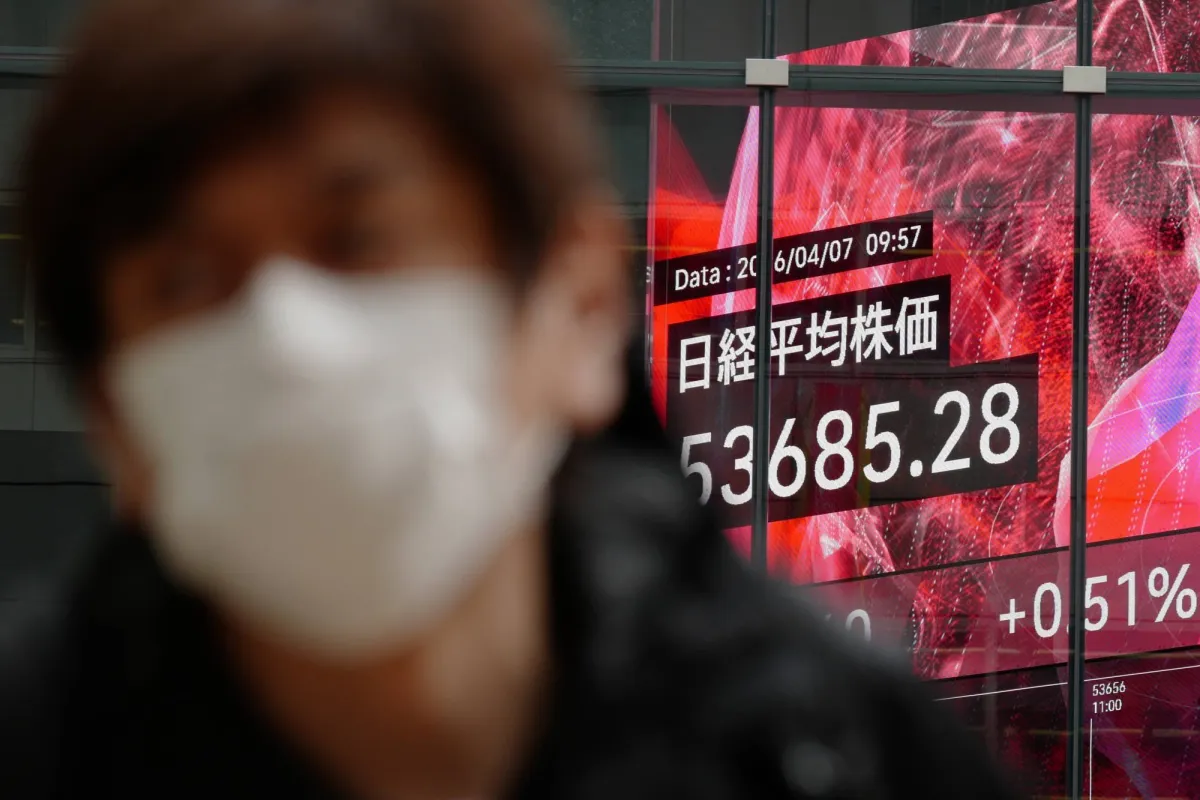
Asian stocks showed a mixed performance in cautious trading on Tuesday, with the sharp rise in oil prices continuing ahead of the deadline set by U.S. President Donald Trump for Iran to reopen the Strait of Hormuz to global shipping or risk having its infrastructure subjected to airstrikes.
In Japan, the Nikkei 225 index fell by 0.2% to 53,310 points, giving up its morning gains. Conversely, the Australian S&P/ASX 200 index rose by 1.5%, while the South Korean KOSPI index remained stable with little change.
Event Details
In China, the Shanghai Composite index increased by 0.4%, while the Hong Kong Stock Exchange was closed due to a public holiday. This Asian divergence follows a slight positive performance on Wall Street, where the S&P 500 index rose by 0.4%, marking its first week of gains in six weeks, and the Dow Jones Industrial Average added 165 points.
In energy markets, U.S. crude jumped by $2.37 to reach $114.78 per barrel, while Brent crude rose by $1.40 to $111.17, levels significantly higher than pre-war levels that hovered around $70.
Background & Context
Oil prices are experiencing sharp fluctuations amid uncertainty regarding the course of the war with Iran and its long-term impact on global energy flows, especially after Tehran rejected a ceasefire proposal on Monday, insisting on the need for a permanent end to the war. A report from Mizuho Daily out of Singapore indicated that Trump's recent moves represent a "cycle of escalation that has been extended multiple times since his initial warning in late March," emphasizing that a comprehensive resolution to the conflict remains elusive amid varying international perspectives.
In the bond market, U.S. Treasury yields for 10 years stabilized at 4.33%, significantly higher than pre-war levels of 3.97%. In the currency market, the U.S. dollar edged up to 159.89 Japanese yen, while the euro dipped slightly to $1.1529.
Impact & Consequences
The U.S. dollar stabilized near its high levels on Tuesday as traders held their breath awaiting the deadline set by the U.S. for Iran to open the Strait of Hormuz to shipping or face strikes targeting its infrastructure. The war in the Middle East and the closure of the vital waterway in the Gulf have led to a surge in energy prices, prompting investors to turn to the dollar as the most effective safe haven, which has bolstered the greenback's gains, particularly in Asian markets.
Although hopes for a deal have tempered the pace of dollar buying during the Easter holiday, tensions prevailed in the markets with a lack of sellers ahead of the deadline set by President Donald Trump at 8 PM Eastern Time (midnight GMT).
Regional Significance
On the ground, Iran and Israel exchanged strikes on Tuesday as Tehran continued to refuse to reopen the Strait of Hormuz. Israel stated that it had completed a wave of airstrikes targeting Iranian government infrastructure, while air defenses intercepted Iranian missiles over Israel and Saudi Arabia. In Asia, the South Korean won remained at weak levels exceeding 1500 won per dollar, a level not seen since the crises of 2009 and the late 1990s, while the Indonesian rupiah fell to a record low.
In conclusion, IMF President Kristalina Georgieva confirmed that the war in the Middle East will lead to rising inflation and a slowdown in global growth, noting that the war's impact on global energy supplies will have far-reaching consequences. Under these circumstances, the economic situation in the Arab region remains under significant pressure, necessitating close monitoring by policymakers.