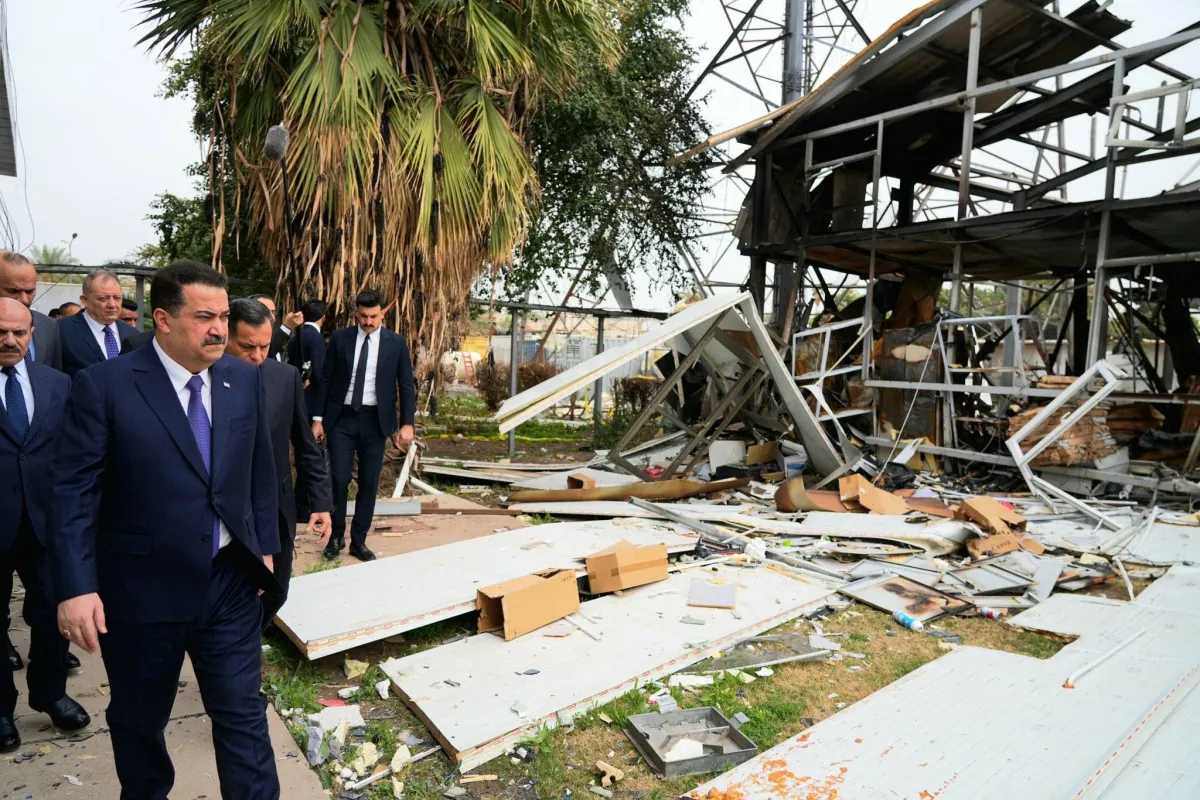
The attack on the Iraqi National Intelligence Service headquarters on Saturday resulted in the death of one officer and injuries to several others, igniting tensions between the Iraqi government and armed factions. In the aftermath of the attack, Prime Minister Mohammed Shia' Al-Sudani described the attackers as a 'cowardly group,' clearly signaling the end of any dialogue opportunities between them.
Al-Sudani, who visited the targeted headquarters on Sunday, expressed his discontent with the increasing assaults on official institutions, calling on political forces to take a serious and clear stance against these threats. This call comes amid a rise in attacks on American interests in Iraq, especially following the ongoing bombardment of the U.S. embassy in Baghdad.
During the visit, Al-Sudani emphasized the need for an investigation into the circumstances of the assault, stating that the government would not hesitate to reveal the perpetrators' identities and bring them to justice, asserting that those committing such crimes do not represent Iraq but seek to strip the nation of its security and stability.
At the same time, Al-Sudani mentioned that the government adopts a wise approach in dealing with the situation, but it will not remain idle in the face of assaults attempting to undermine state institutions. He pointed out that the decision of war and peace must remain exclusively in the hands of the state, and any other action threatening national security represents an unacceptable infringement.
In a related context, the National Intelligence Service announced that its headquarters was subjected to what it described as a 'terrorist' attack, indicating that this assault is part of armed groups operating outside the law. However, Al-Sudani also denied that there is any mandate for National Security Advisor Qassem Al-Araji to conduct dialogue with the armed factions, reflecting the tense situation between the government and these groups.
These events coincide with previous attempts to reach a ceasefire between Iraqi factions and the United States, as a proposal was put forward to halt attacks on the U.S. embassy in exchange for stopping operations against faction leaders. However, tensions escalated following the recent attack, deepening divisions among various political factions.
In this context, former Parliament Speaker Mahmoud Al-Mashhadani called for a 45-day state of emergency to control the situation. His call comes amid ongoing political struggles over electing a new president and forming a government following the recent elections. This move reflects the significant challenges facing political forces in Iraq and threatens the country’s stability.
Ultimately, these developments indicate a serious escalation in the security and political situation in Iraq, where dialogue seems to be increasingly elusive. Political forces and the international community must recognize the magnitude of the challenges at hand and work toward peace and stability in Iraq, which is a crucial hub in the Middle East.
The continuing violence and armed assaults negatively impact state-building efforts, plunging Iraq back into chaos and underscoring the urgent need for fundamental solutions based on dialogue and reconciliation.