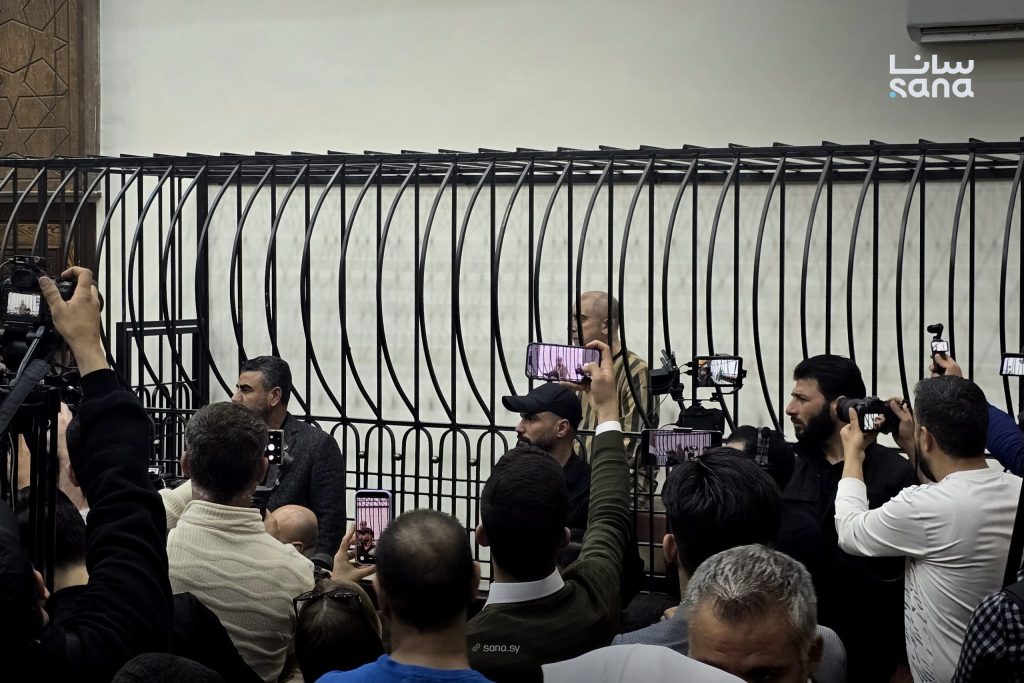
On April 26, 2026, the Fourth Criminal Court at the Palace of Justice in Damascus held a preliminary session deemed the most significant since the fall of the Assad regime. General Atif Najib, a cousin of Bashar Assad, appeared in the dock in handcuffs, with the presence of the public prosecutor and families of victims from Daraa governorate.
Najib was not interrogated, and no testimonies were heard, as the session was adjourned until May 10, 2026, when substantive proceedings are expected to begin. Although the proceedings were routine from a procedural standpoint, their significance for the structure of accountability in Syria is entirely different.
Details of the Event
Najib was appointed head of the Political Security Branch in Daraa and was arrested in Latakia in January 2025. He is accused of overseeing arrests and interrogations, as well as issuing orders for violent responses to protests in March 2011, which led to civilian casualties and the detention and torture of thousands of Syrians.
The official charges against him include crimes against the Syrian people, encompassing murder, torture, and overseeing widespread violations against civilians. Additional charges have been leveled against other defendants related to extortion and drug trafficking.
Background & Context
The symbolism of these charges highlights the importance of Daraa as the cradle of the Syrian uprising, where Najib is seen as a direct link between the regime's security apparatus and that foundational moment. However, the legal framework underpinning these charges faces structural limitations, as the Syrian Penal Code does not explicitly criminalize crimes against humanity.
Instead, crimes are prosecuted under ordinary criminal law provisions, meaning that any conviction will not reflect the systematic nature of the crimes but will only record individual acts.
Impact & Consequences
This trial is a true test of the integrity of judicial procedures in Syria. In the same court, absentia charges have been brought against Bashar Assad and Maher Assad, reflecting a desire to hold high-ranking officials accountable. However, the feasibility of enforcing these charges remains slim, especially with Bashar Assad currently in Russia, which does not have an extradition treaty with Syria.
Absentia proceedings are seen as tools for building the legal framework for accountability, although they do not provide an immediate enforcement mechanism. Furthermore, constructing a cohesive legal file based on forensic evidence is a prerequisite for any request for cooperation with Interpol.
Regional Significance
The trial of Atif Najib is an important step towards achieving justice in Syria and may influence the trajectory of transitional justice in the region. The success of this trial could encourage affected communities in other countries to demand accountability for human rights violations.
Ultimately, questions about the integrity of the trial and the rights of victims remain, as justice awaits realization under complex circumstances. The trial of the younger Najib may pave the way for accountability of the elder Najib, reflecting the aspirations of the Syrian people for justice.