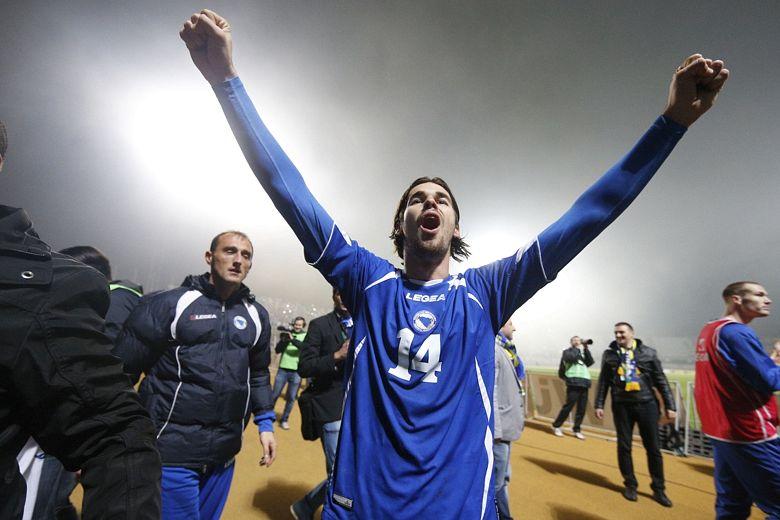
Bosnia and Herzegovina has qualified for the World Cup finals after an exciting match against Italy, which ended in a 1-1 draw, with the penalty shootout favoring the Bosnian team. Team captain Edin Dzeko, who was unable to participate in the shootout due to his injury, described what happened as fate.
In the match held in the city of Zenica, the Bosnian team displayed a high fighting spirit, managing to equalize against Italy after they had taken the lead with a goal. Although Dzeko was seen with an ice pack on his shoulder after sustaining an injury in the final moments of the match, his teammates succeeded in securing victory in the penalty shootout.
Match Highlights and Key Moments
The match featured thrilling events, including the ejection of an Italian player in the second half, which provided Bosnia with an opportunity to pressure their opponent. Despite this, Dzeko suffered an injury in the last minute, raising concerns among Bosnian fans. Nevertheless, the Bosnian team demonstrated great composure under pressure, successfully converting all four of their penalty kicks, while the Italian team missed two.
Dzeko, regarded as one of the most prominent players in Bosnia's history, expressed his happiness at his team's qualification, despite not being able to take a penalty kick. He stated, "It seems that what happened was fate, as I got injured at the last moment and couldn't take a penalty." He confirmed that he is optimistic about his recovery and may return to the field within a month or a month and a half.
Background & Context
Historically, Bosnia had qualified for the World Cup only once, in 2014, where they performed well in the tournament. Their current qualification reflects the development of football in the country, especially after the conflicts experienced in the 1990s. Dzeko is considered a symbol of Bosnian football, having significantly contributed to the team's successes.
Bosnia's qualification also reflects the noticeable improvement in the performance of smaller teams in Europe, where the competition for World Cup qualification has become fiercer. This qualification represents a significant achievement for Bosnian football and enhances its status on the global sports stage.
Impact & Consequences
Bosnia's qualification for the World Cup is expected to have positive effects on sports in the country, likely increasing the popularity of football and motivating youth to engage in sports. Additionally, this achievement may contribute to improving the country's overall image on the international stage.
Moreover, Bosnia's success in qualifying could open doors for new investments in the sports sector, enhancing the development of sports infrastructure in the country.
Regional Significance
Bosnia's qualification for the World Cup highlights the importance of sports in promoting national identity, which could serve as a lesson for Arab countries seeking to enhance their status in the global sports arena. This achievement may also encourage Arab nations to invest more in sports and develop their talents.
In conclusion, Bosnia's qualification for the World Cup represents a historic achievement, reflecting the ability of smaller teams to compete at the highest levels. Dzeko's injury reminds us that sports are full of surprises, and fate can play a role in determining the destinies of teams and players.