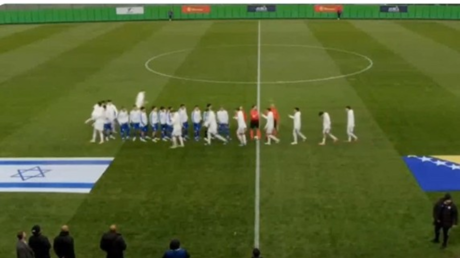
In a notable incident during the match between the national teams of Bosnia and Herzegovina and Israel, held on Tuesday evening in the Hungarian capital Budapest as part of the UEFA U21 Championship qualifiers, Bosnian players ignored the customary handshake with their Israeli counterparts before the match commenced.
This behavior has triggered widespread reactions on social media, with many interpreting it as a clear political stance regarding the Palestinian issue. Television footage showed Bosnian players heading directly to their positions without extending their hands for a handshake, raising questions about the messages conveyed by this action.
Details of the Incident
The match, part of the UEFA U21 qualifiers, was an opportunity for players to showcase their skills on an international level, but it turned into a significant political event. Traditionally, players exchange greetings before the match, but this time, the Bosnian players chose to abstain from this custom, reflecting their stance on the Israeli-Palestinian conflict.
It is worth noting that the Bosnia and Herzegovina national team has previously expressed support for the Palestinian cause on various occasions, reflecting the general sentiment in the country towards this issue. This incident has been viewed as a strong message from the players to the international community regarding their position on the Israeli occupation.
Background & Context
Historically, relations between Bosnia and Herzegovina and Israel have been tense, with Bosnia refusing to recognize Israel as a state. These positions date back to the civil war in Bosnia in the 1990s, during which there was significant Palestinian support from Bosnians. Numerous studies have shown that the Bosnian people tend to sympathize with the Palestinian cause, which is evident in their political and social stances.
In recent years, relations between Islamic countries and Israel have seen increasing tensions, especially following recent events in Gaza and Jerusalem. This incident comes at a sensitive time, as calls for boycotting Israel are rising in the Islamic world, reflecting the impact of politics on sports.
Impact & Consequences
This incident could affect sports relations between Bosnia and Israel and may lead to calls for boycotting future matches. It may also encourage other countries to adopt similar stances, complicating international relations in the sports arena.
Furthermore, this incident may impact young players aspiring to pursue professional careers abroad, as their career paths could be influenced by international politics. This event could raise awareness of the Palestinian cause among young athletes in Bosnia.
Regional Significance
This incident serves as a powerful reminder to Arabs about the Palestinian cause, highlighting the importance of Arab support for this issue. The stance taken by Bosnian players may encourage Arab athletes to express their political and social views, reflecting the intersection of sports and politics.
Ultimately, this incident reflects the challenges faced by sports amidst tense political conditions and underscores the importance of awareness regarding humanitarian issues across all fields, including sports.