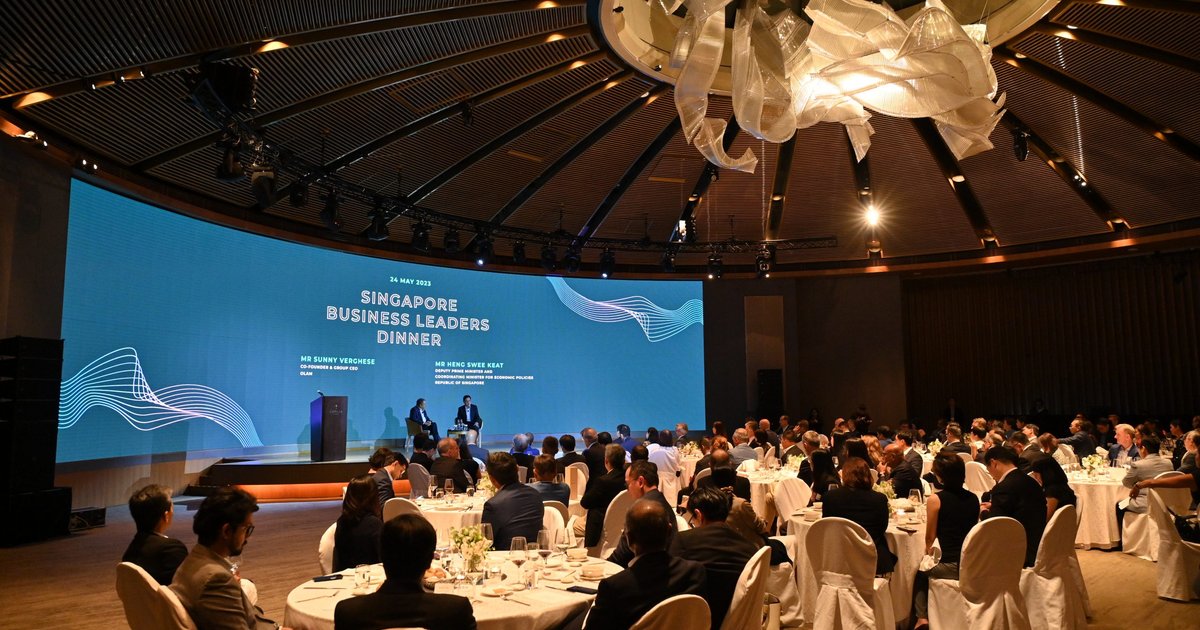
Business leaders worldwide are facing a new reality characterized by wars, inflation, and artificial intelligence, where these challenges have become part of daily life. At the Converge Live conference held in Singapore, over 30 executives discussed how uncertainty has become structural rather than incidental.
Tan Su Shan, the CEO of DBS Bank, emphasized that the key lesson is the necessity of managing businesses with maximum flexibility. She stated, "If you are a manager, you must operate with utmost flexibility, as you never know what will happen tomorrow." She highlighted the importance of conducting stress tests to prepare for the worst.
Event Details
The discussions revealed that the pace of crises has accelerated, starting from the COVID-19 pandemic to trade wars and geopolitical conflicts. Stanley Zito, President of Lever Style, noted that long-term planning has become more challenging, prompting companies to abandon traditional planning cycles.
Instead, leaders are operating in a state of constant emergency planning. Thomas Knudsen, Managing Director of Pandora, explained that "being prepared for crises has become more important than ever."
Background & Context
Historically, global markets have experienced significant fluctuations due to economic and political crises. However, the current situation is characterized by the interplay of multiple factors, such as rising energy prices due to conflicts in the Middle East, which increase inflationary pressures on companies.
Challenges in supply chains are increasing, as Rajalingam Subramaniam, CEO of Fleet Management Limited, pointed out that over 2,000 ships are stuck in the Arabian Gulf, affecting around 30,000 sailors.
Impact & Consequences
These crises are affecting production costs, with Zito stating that rising shipping costs are reflected in clothing prices. He confirmed that "raw material prices are rising, which increases inflationary pressures." Companies are adapting to these challenges, but often at a higher cost.
Some companies are turning to air freight despite its high costs, as Knudsen noted that "the ability to adapt is key." However, these costs will ultimately be passed on to consumers.
Regional Significance
The Arab region faces similar challenges, as its economies are affected by global fluctuations in energy prices and supply chains. These challenges may impact the ability of Arab countries to achieve sustainable economic growth.
It is crucial for companies in the region to adopt flexible strategies to adapt to these changing conditions, helping them remain competitive.