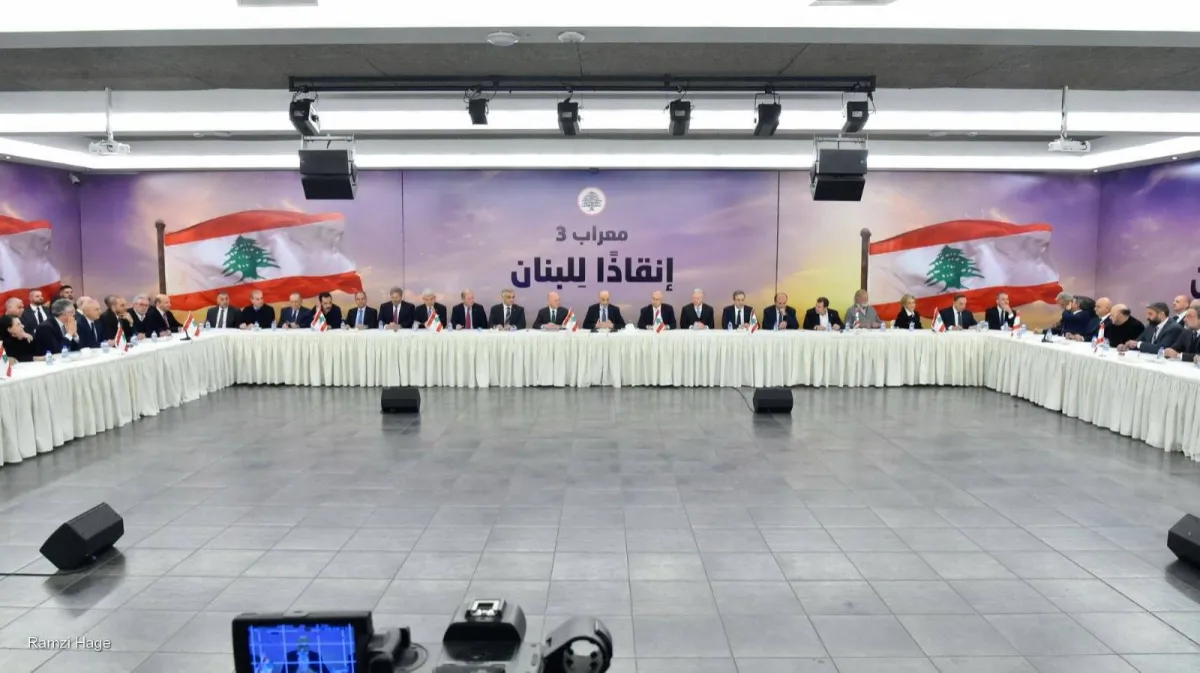
During the 'Save Lebanon' conference organized by the Lebanese Forces, leader Samir Geagea called for the necessity of restricting arms to the state and holding accountable those responsible for the tragic conditions in Lebanon. Geagea emphasized that Lebanon is not Iran, warning that the situation could deteriorate further if not addressed.
Geagea stressed that the responsibility for implementing state decisions does not rest solely on ministers but includes all official administrations, including judicial, security, and military sectors. The conference was attended by representatives from opposition parties and political and media figures against Hezbollah, where a concluding statement was issued calling for the implementation of international resolutions and the assistance of international forces if the state fails to impose its sovereignty.
Event Details
During the conference, Geagea reviewed the course of previous events, noting that most militias were disbanded between 1992 and 1994, while Hezbollah continued under the guise of resistance, which Geagea considered inconsistent with the Taif Agreement. He also pointed out that political forces made significant efforts to avoid reaching the current situation, but conditions worsened with the outbreak of the Gaza support war.
Geagea explained that repeated warnings to avoid escalation did not yield results, as some continued the approach that led the country to this stage. He also mentioned the number of martyrs who fell along this path, expressing regret over the current situation despite all the sacrifices.
Background & Context
These calls come at a time when Lebanon is experiencing economic and security deterioration, with citizens suffering from multiple crises. The concluding statement of the conference considered Hezbollah's support for Gaza since late 2023 a turning point that dragged Lebanon into a conflict unrelated to it, leading to a violation of the country's sovereignty.
The statement also held the Iranian regime politically and legally responsible for using Lebanese territory in the regional conflict, indicating that Hezbollah bears executive responsibility for the damages inflicted on Lebanon.
Impact & Consequences
The attendees expressed the necessity for a comprehensive documentation of the damages resulting from the war, including human and material losses, in preparation for demanding compensation from Iran through legal channels. They also announced the intention to establish a special court to hold accountable those responsible for dragging Lebanon into the war, affirming that the era of impunity must end.
The statement emphasized that the continued presence of arms outside the framework of the state poses an existential threat to the Lebanese entity, demanding strict implementation of government decisions and the completion of the deployment of the Lebanese army across all territories.
Regional Significance
Concerns are growing that the ongoing situation in Lebanon could exacerbate crises in the region, especially with increasing regional tensions. The attendees called for the necessity of protecting Lebanon from the continuation of the current reality, indicating the possibility of seeking international forces if the state fails to impose its sovereignty.
In light of these circumstances, Lebanon faces a decisive choice: either a strong state capable of imposing its sovereignty or a continuation of chaos and division. The conference's calls represent a cry to save Lebanon from successive crises and a reaffirmation of the need to rebuild the Lebanese state on strong foundations.