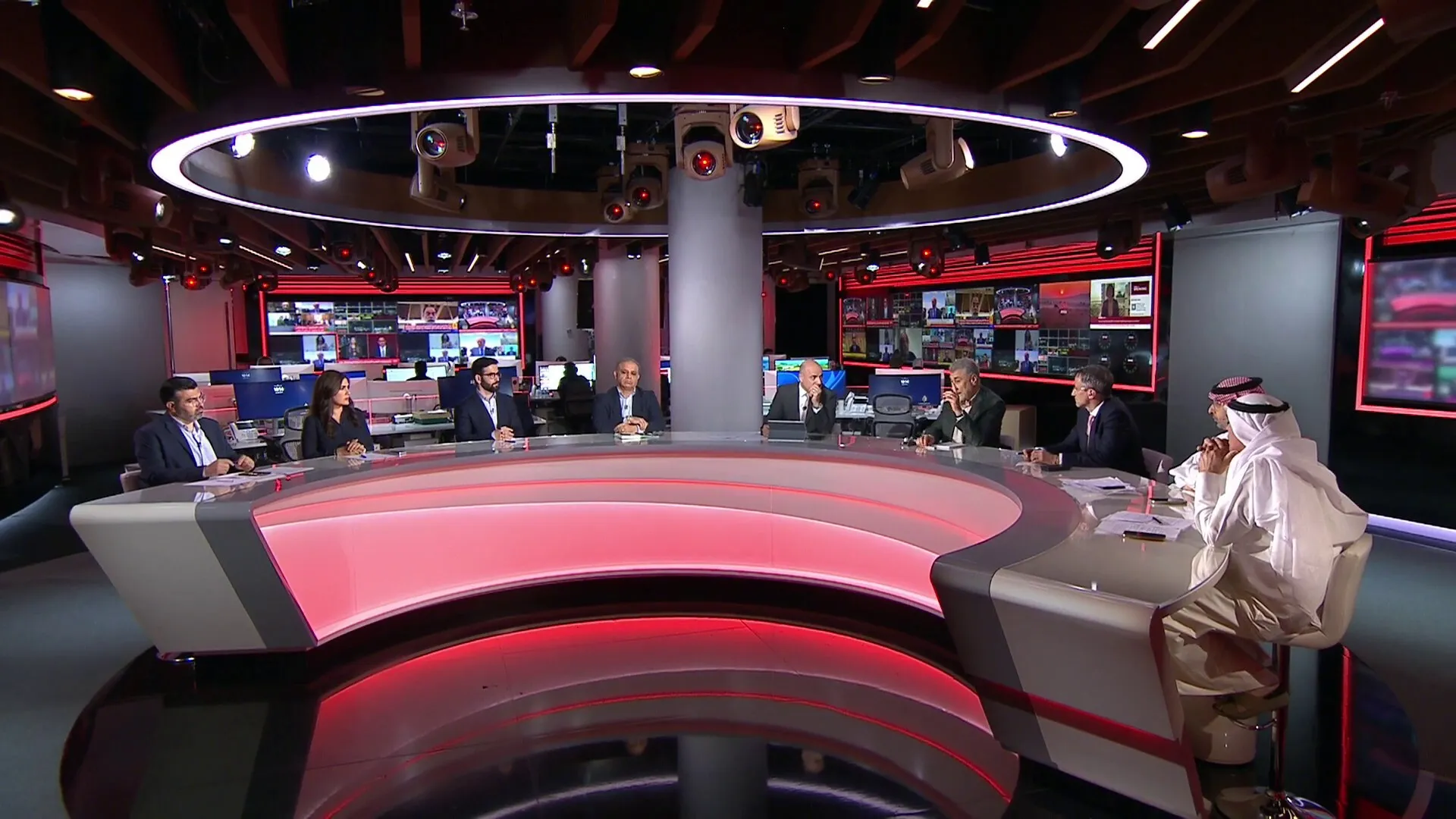
The cancellation of U.S. President Donald Trump's delegation visit to the Pakistani capital, Islamabad, has reshuffled the cards in the tense relationship with Iran. This decision reveals the extent of the disparity in narratives and assessments among the involved parties, at a time when the paths of war and negotiation intertwine, and doubts about the viability of any diplomatic route are escalating.
At the outset of the discussion, the host of the "Hour Debate" program, Hassan Jamoul, painted a general picture reflecting the stagnation dominating the scene, describing it as a state of "no war, no peace, no negotiations, and no agreement." This state seems to be the only point of consensus among all parties, alongside the ongoing manifestations of indirect escalation, such as the mutual detention of ships.
Event Details
Jamoul questioned the reasons behind the failure of the second round of talks and how Iranian Foreign Minister Abbas Araghchi's visit transitioned from a diplomatic tour to a stop that yielded responses described by Washington as "nothing." He also questioned the source of the confidence Trump previously expressed regarding his expectation of an Iranian offer that would meet U.S. demands, only to later confirm that he did not know who the real decision-maker was in Iran.
In this context, former Deputy Assistant Secretary of State, Ambassador Joy Hood, provided two possible explanations for what transpired, drawing on his diplomatic experience. He suggested that one reason could be a misunderstanding in communications, especially since most of the communication between the U.S. and Iran occurs away from the spotlight, opening the door to conflicting messages.
He also did not rule out that Trump received signals indicating Iranian readiness to engage in talks, only for this position to change later from the Iranian side. Another possibility he raised was the "excessive enthusiasm" of Pakistani mediators, who may have exaggerated positive expectations regarding Tehran's willingness to respond to Washington.
Context and Background
Conversely, Hassan Ahmadian, a professor of Middle Eastern studies at the University of Tehran, rejected this narrative, asserting that Araghchi's visit was not linked to negotiations with the United States but was part of interactions with Pakistani mediation. Ahmadian attributed the failure of the second round of indirect talks between Iran and the U.S. in Pakistan to structural factors related to Tehran's rejection of U.S. proposals and the accumulated lack of trust between the two sides.
He emphasized that this failure was not surprising but rather a natural outcome of a negotiation process that Iran considers futile under the proposed conditions. He also noted that Tehran has denied from the outset any intention to hold direct meetings, despite the U.S. side announcing the dispatch of envoys.
Impact and Consequences
He argued that Washington is attempting through these proposals to appear as the party that has not failed militarily by presenting conditions it knows in advance that Iran will reject. This has led Tehran to approach any negotiation path with caution, viewing it as an extension of the war through political and diplomatic means.
He also pointed out that the experience of the 2015 nuclear agreement represented a significant shift in Iran's perspective, as it now sees any new concession as potentially opening the door to additional demands that could affect its independence, which explains its insistence on a high negotiation ceiling not lower than the 2015 agreement.
Impact on the Arab Region
Regarding regional escalation, Ahmadian confirmed that threats of using force, including nuclear options, remain within the framework of mutual deterrence. He warned that any escalation could lead to broader responses in the region. He also noted the conflict's shift towards more complex tools, including economic pressures and unconventional movements, such as border infiltration attempts.
He affirmed that the lack of trust, differing objectives, and ongoing pressures make it difficult to resume effective negotiations soon, predicting that the situation will remain within the equation of "no war, no peace" with ongoing confrontation without resolution.
In this context, Mahjoub Al-Zuwairi, an academic and expert on Middle East policies, provided a detailed reading of the scene, considering that the Pakistani mediation carried written proposals to Tehran, which were later conveyed to Washington.
He explained that the Iranians needed about ten days to prepare their response, which displeased the Pakistani mediator. He speculated that the Iranian response carried by Araghchi did not meet U.S. expectations, particularly on two key issues.
In assessing the nature of the phase, Hisham Al-Ghanam, a research fellow at the Carnegie Endowment for International Peace, noted that what is happening cannot be described as real negotiations but is closer to a preparatory phase preceding negotiations, given the deep lack of trust between the two sides.
He pointed out that there exists "suspicion, doubt, and cultural and political misunderstanding," to the extent that the language used in communication between the two sides seems to be non-shared, complicating any progress. He also noted that neither side appears eager to reach an agreement, as each believes it can achieve greater gains through the field.
For his part, Laqaa Maki, a senior researcher at the Al Jazeera Center for Studies, considered that what happened has returned matters to square one, pointing out that U.S. expectations leaned towards Iran making quick concessions, which did not occur.
He affirmed that the Iranian response was expected and reflects Tehran's insistence on its ability to reject U.S. conditions. He also raised the possibility that Iran seeks to improve its negotiating terms through continued field pressure, suggesting that the next phase may head towards one of two options.
In this same vein, Saleh Al-Mutairi, head of the Al-Madar Center for Political Studies, indicated that what is happening does not reflect the absence of war but its continuation through different tools, noting that both sides are seeking to achieve gains without slipping into a comprehensive confrontation.
He speculated that the United States might resort to limited military operations in terms of time and objectives, similar to what he described as a short war model, to achieve political goals without broad escalation.
For her part, Negar Mortazavi, a senior researcher at the Center for International Policy in Washington, provided a broader analysis, considering that the crisis between Washington and Tehran is based on two fundamental problems.
She noted that the current war lacks popularity within the United States or internationally, and its continuation could lead to prolonged exhaustion, especially with the possibility of Iran escalating through unconventional means.
In a strategic reading, Ali Murad, an academic and political researcher, described the current phase as managing the blockage of options, where neither war represents a solution, nor does negotiation seem possible at this time.
He pointed out that what is happening reflects a continuous intertwining of war and negotiation, which may persist for a long time, with potential impacts on regional countries that may find themselves the biggest losers in this conflict.
Regarding the nuclear file, it has emerged as one of the most prominent points of contention, where Ahmadian confirmed that Iran's insistence on the gains of the 2015 agreement is not only due to it being a precedent but also due to a loss of trust in the United States, which may withdraw from any future agreement.
Conversely, Laqaa Maki warned that returning to the 2015 formula may not be regionally acceptable and could push towards an arms race in the region.
In the military aspect, Joy Hood considered that the war has not actually stopped but continues at different levels, whether through naval movements or regional tensions, warning that the United States still has additional escalation options, despite the associated risks, especially given the sensitivity of the energy file and the Strait of Hormuz. Concerns were also raised about the use of more dangerous tools, including scenarios related to nuclear escalation, even if currently unlikely.