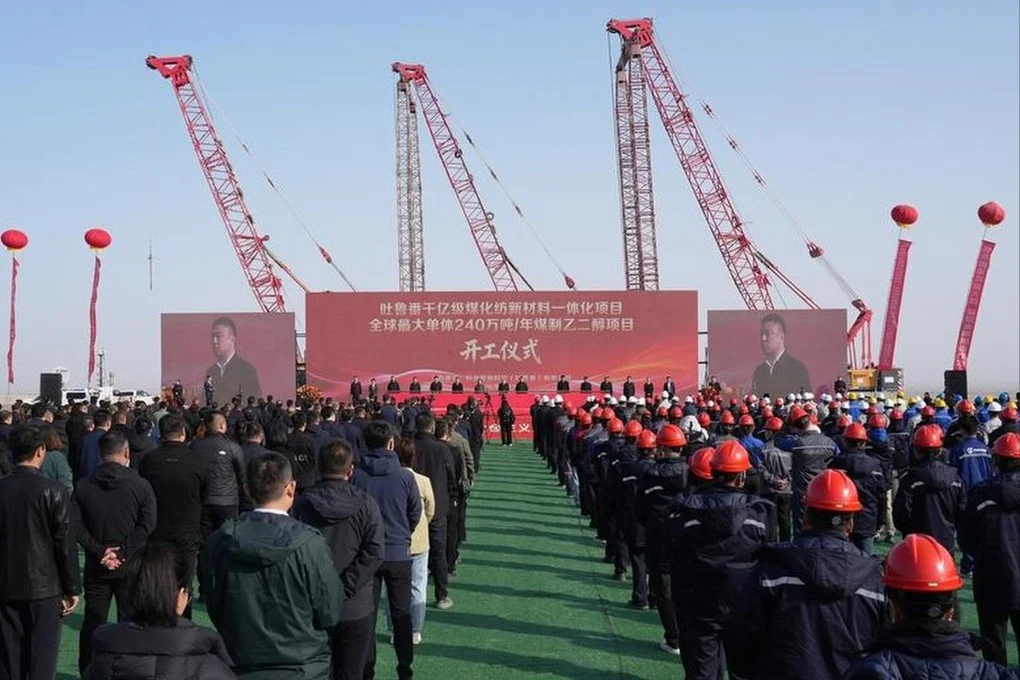
China has announced the start of construction on the world's largest coal-to-ethylene glycol project, aimed at boosting the production of essential chemicals for its green technologies. Launched on March 20, the project is located in the Turkistan province and aims to produce 2.4 million tons annually, according to the Chinese news agency Xinhua.
This move comes at a time when global chemical supplies are facing disruptions due to conflicts in the Middle East, prompting China to enhance its investments in this vital sector. Beijing seeks to secure what it calls "industrial gold" necessary for developing its green technologies, reflecting China's strategic shift towards reliance on alternative energy sources.
Project Details
The new project in Turkistan is considered the largest of its kind globally, utilizing coal as the primary source for producing ethylene glycol, a key chemical used in the production of fibers and plastics. This type of production is part of China's strategy to enhance its production capabilities amid global challenges.
China aims to significantly increase its chemical production, as ethylene glycol is a fundamental component in many industries. The project is expected to contribute to reducing dependence on imports of these materials, thereby enhancing China's competitive edge in the global market.
Background & Context
Historically, China has heavily relied on imports to meet its chemical needs. With escalating tensions in the Middle East, particularly conflicts affecting energy supplies, China has begun to reassess its production strategies. This shift towards increasing domestic production reflects China's desire for self-sufficiency in this critical sector.
Moreover, this project aligns with China's efforts to achieve its environmental goals, as it seeks to reduce carbon emissions and promote the use of clean technologies. This initiative is expected to contribute to balancing economic growth with environmental preservation.
Impact & Consequences
This step is significant not only for China but for the entire world, as it will impact global chemical markets. With increased domestic production, global chemical prices may decline, potentially affecting manufacturers in other countries.
Furthermore, this project could heighten trade tensions between China and other nations, especially those that rely on exporting chemicals to China. The enhancement of local production may also encourage other countries to adopt similar approaches, leading to substantial changes in global supply chains.
Regional Significance
In the Arab region, this development may have multiple implications. Oil and gas-producing countries, such as Saudi Arabia and the UAE, may face new challenges in the chemical market. Additionally, ongoing conflicts in the Middle East could affect market stability, making it essential for Arab nations to consider new strategies to enhance their production capabilities.
In conclusion, China's coal-to-ethylene glycol project represents a strategic move aimed at boosting local production and reducing reliance on imports. Amid global tensions, this project may have far-reaching effects on global markets, warranting close monitoring by Arab countries.