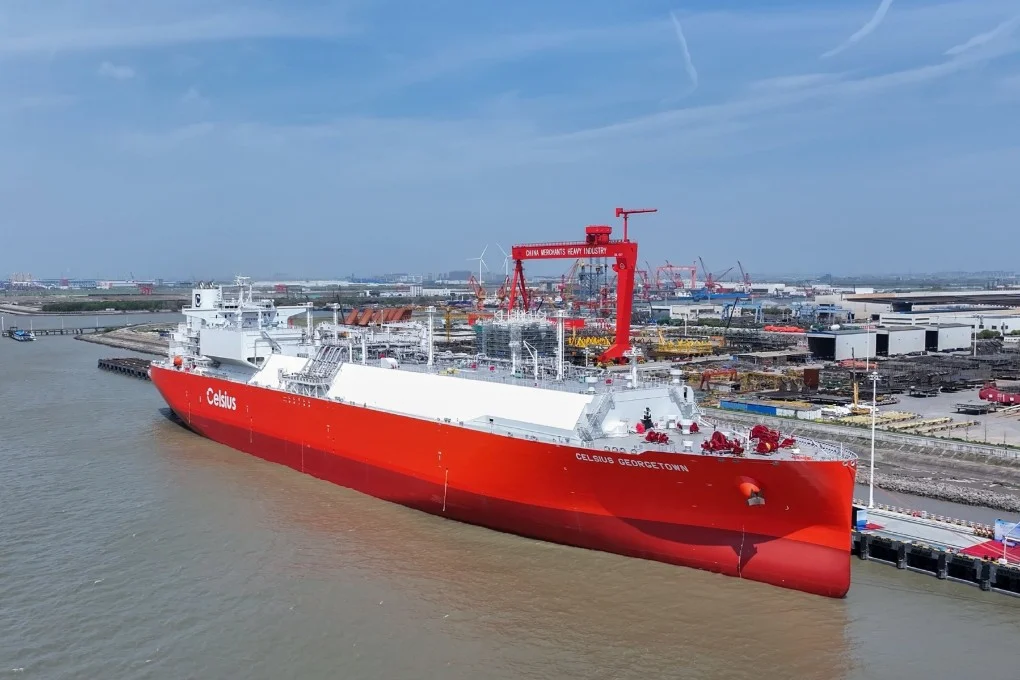
China has delivered its largest liquefied natural gas (LNG) carrier in history, reflecting a remarkable development in its industrial capabilities. The carrier, designed and built by China National Heavy Industry (Jiangsu), has a capacity of 180,000 cubic meters and was delivered last Sunday.
This achievement is considered a milestone in China's efforts to enhance its position in the shipbuilding market, with the number of domestic shipyards capable of designing and constructing these advanced carriers rising to five. This comes at a time when China is striving to compete with South Korea, which is regarded as a leader in this field.
Details of the New LNG Carrier
The delivery of the new carrier is part of China's strategy to boost its capabilities in the liquefied natural gas industry, which is considered a vital sector in the global economy. The new vessel is part of China's efforts to reduce dependence on energy imports and enhance its ability to export LNG to global markets.
The manufacturer, China National Heavy Industry, is one of the largest companies in this field and has shown an increasing ability to compete with South Korean firms. This achievement demonstrates how China is heavily investing in developing shipbuilding technologies, thereby strengthening its position in the global market.
Background & Context
Over the years, South Korea has dominated the shipbuilding market, particularly in the LNG carrier sector. However, China has begun taking serious steps to change this situation, investing in the technology and infrastructure necessary to build advanced vessels.
Historically, China relied heavily on foreign companies in this field, but with technological advancements and innovation, it has become capable of achieving significant milestones in shipbuilding. This shift is part of China's broader vision to enhance its industrial capabilities and reduce reliance on foreign entities.
Impact & Consequences
This achievement has significant implications for the global industry. With China's increased capacity to build LNG carriers, we may witness a shift in market dynamics, where heightened competition could lead to lower prices and improved quality.
Moreover, this development could enhance China's ability to export LNG to global markets, contributing to the strengthening of its economy. This achievement also illustrates how innovation and technology can alter the balance of power in global markets.
Regional Significance
The implications of this advancement extend beyond China, as it could open new opportunities for Arab countries in LNG exports. As China strengthens its position in the LNG market, it may lead to increased collaboration and trade opportunities within the region.
In conclusion, this milestone not only highlights China's progress in shipbuilding but also signifies a potential shift in the global LNG market landscape, with implications for various stakeholders.