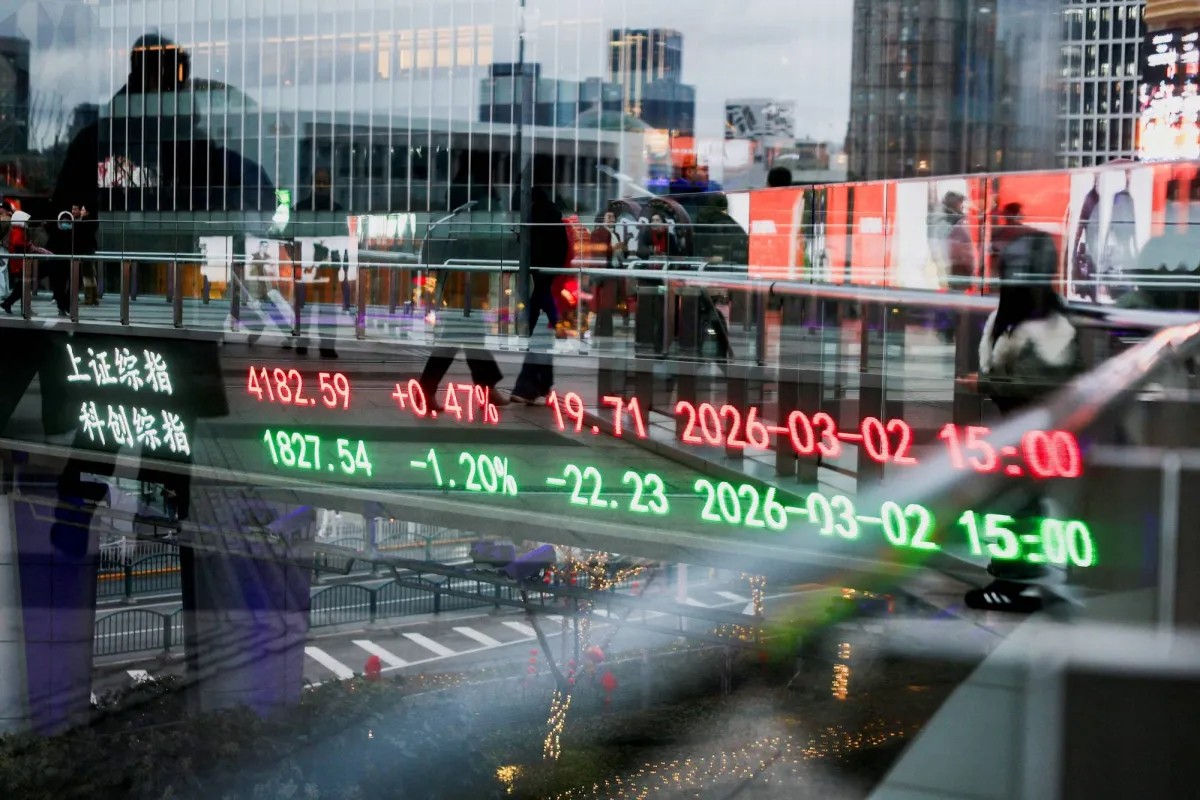
Chinese stocks have recorded a decline for the second consecutive week, despite a recovery on Friday, as technology companies face increasing profit-taking pressures. Meanwhile, the Hong Kong market rose, driven by Lenovo's results that exceeded expectations, contributing to improved sentiment.
The CSI 300 index of leading Chinese stocks ended the session up by 1.3%, but fell by 0.3% over the week. The Shanghai Composite Index also rebounded, having recorded its largest drop since March on Thursday, rising by 0.9%. In Hong Kong, the Hang Seng Index rose by nearly 1%, driven by technology stocks, with Lenovo's shares jumping by 20% to their highest level in 26 years.
Event Details
Chinese stocks have been rising this year, as optimism stemming from artificial intelligence has helped overcome investors' concerns about the overall economy. BNP Paribas noted a significant improvement in earnings forecasts in China and some other Asian economies, but added, "However, this is not a comprehensive improvement; it is almost entirely driven by the accelerating technology cycle."
The bank warned that "any reversal of the (technology) cycle would pose a significant obstacle to regional stock markets," but it "remains the only influencing factor in the short term." Goldman Sachs painted a picture of a divided Chinese economy, where the thriving technology sector contrasts with struggling sectors of the "traditional economy."
Background & Context
Goldman Sachs clarified in a note that "the ongoing conflict in the Middle East and rising energy prices have negatively impacted the Chinese economy... However, the Chinese economy has so far shown greater resilience than expected in adapting to rising oil prices." The bank advised investors to closely monitor Chinese exports, which are a key driver of growth.
It added that "there are some encouraging signs from the real estate market in major cities." Technology stocks sharply rebounded after their decline on Thursday, with the Chinext index for startups in Shenzhen and the CSI Electronics index rising. In Hong Kong, the Hang Seng Tech Index also climbed, while the semiconductor manufacturing index surged.
Impact & Consequences
The Chinese yuan has slightly declined against the dollar, as traders closely monitor U.S.-Iran talks and inflation concerns stemming from the war, which have pushed U.S. bond yields higher. In the short term, analysts expect the yuan to fluctuate against the dollar, which has diminished in attractiveness as tensions in the Middle East ease, but is supported by the Federal Reserve adopting an increasingly tight monetary policy.
Nanhua Futures noted in a memo that "speculators on both sides of the dollar are intensifying," predicting that the yuan will fluctuate around 6.8 yuan to the dollar as a result. On Friday, the yuan was traded in the local market at 6.7998 yuan to the dollar, marking a slight decline from Thursday's close.
Regional Significance
Developments in the Chinese market are particularly significant for the Arab region, as many Arab economies have close trade relations with China. Any decline in Chinese economic growth could impact exports and imports in the region, necessitating careful monitoring by investors and decision-makers.
In conclusion, Chinese markets remain under profit-taking pressure, raising questions about the sustainability of the recovery amid increasing global economic challenges.