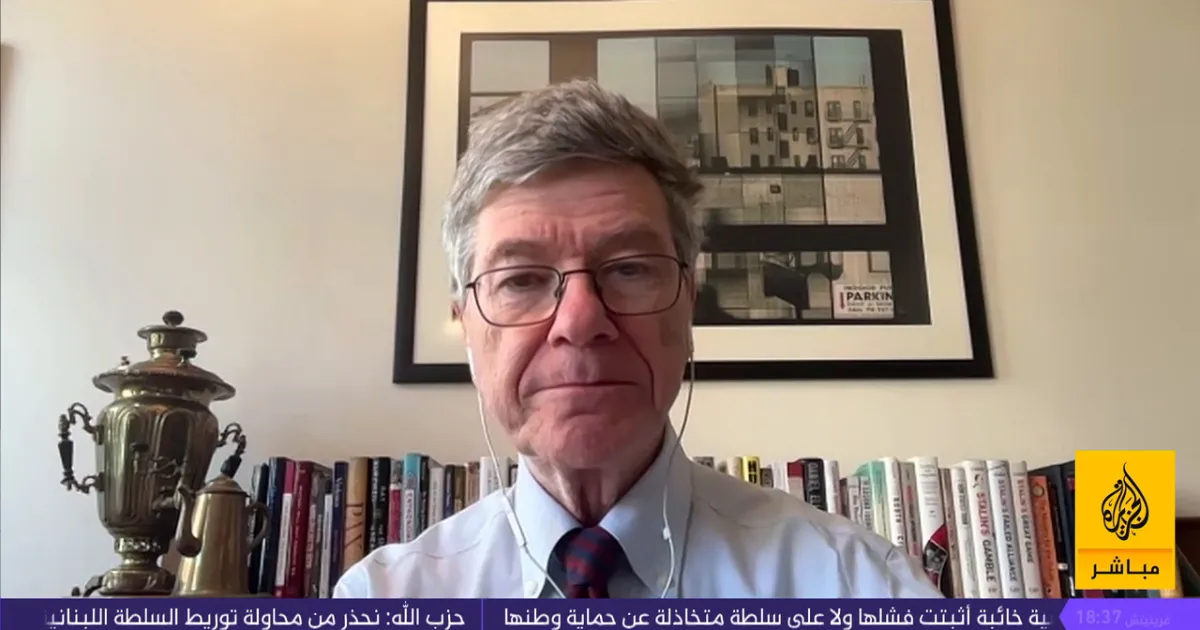
American thinker and director of the United Nations Sustainable Development Solutions Network, Jeffrey Sachs, has unveiled a new perspective on the U.S.-Israeli war on Iran, labeling it a "war of illusions" based on erroneous assessments regarding the possibility of subduing Iran through force. He noted that the lack of international support for this war stems from the absence of a realistic path to achieve its objectives.
In statements made to Al Jazeera Mubasher, Sachs asserted that the current war has been orchestrated by only two figures: Benjamin Netanyahu and Donald Trump, pointing out that this war lacks any broad popular support within the United States or Europe. He urged world leaders, including Gulf states, to take a clear stance to halt the war, warning that its continuation would only lead to further chaos.
Details of the Conflict
Sachs discussed the political proposals put forth for the region, emphasizing that no peace can be achieved without the establishment of a Palestinian state. He argued that the core of the regional conflict is tied to the absence of a just solution to the Palestinian issue in accordance with international law, advocating for the establishment of a Palestinian state alongside Israel in Gaza, Jerusalem, and the West Bank. He believes that rejecting this solution fuels the cycle of conflicts in the region.
Sachs strongly criticized U.S. policies in the Middle East, indicating that what he termed the "Zionist lobby" in the United States has contributed to foreign policies that have led to a series of wars in several countries in the region, such as Iraq, Syria, Yemen, and Libya. He considered that the continuation of these policies hampers peace prospects.
Historical Context
Historically, U.S.-Israeli relations have been marked by ongoing tensions with Iran, as both the United States and Israel view Iran as a threat to regional security. These dynamics have led to escalating military tensions, negatively impacting stability in the region. In recent years, military and economic pressures on Iran have increased, prompting it to adopt more aggressive policies.
The Palestinian issue remains a central focus in the Middle East conflict, as Palestinians demand their national rights while facing significant challenges under Israeli occupation. Many analysts argue that resolving this issue is key to achieving lasting peace in the region.
Consequences and Effects
Sachs pointed out that statements from the U.S. president about achieving victory in the war against Iran do not reflect reality, asserting that the situation continues to suffer from a deep crisis. He highlighted the ongoing economic tensions, rising energy prices, and disruptions in navigation in some vital corridors, reflecting the war's failure on all levels.
He stressed that ending the war is immediately possible through the withdrawal of the United States and Israel, warning that its continuation will lead to catastrophic costs for the region and the world. He called for a return to political solutions and opening the door to comprehensive regional stability.
Impact on the Arab Region
Sachs's statements indicate a growing criticism of U.S. policies in the Middle East, as many Arab leaders seek peaceful solutions to ongoing conflicts. This situation reflects the urgent need to reassess current strategies to achieve security and stability in the region.
In closing, Sachs commented on the assassination attempts targeting President Donald Trump, noting that these incidents reflect a deep-seated issue within American society related to gun proliferation and internal division. However, he ruled out any direct impact on the course of the ongoing war.