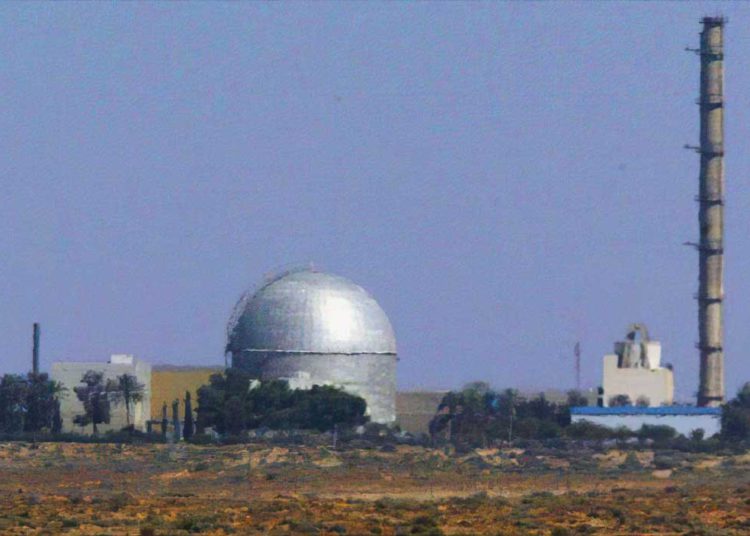
The city of Dimona in the Negev Desert, one of the remote areas of historic Palestine, has transformed from a small settlement for Jewish immigrants into a secret center for Israel's nuclear program. Founded in 1955 with support from the Israeli government, it was intended as a refuge for immigrants from various countries, but it quickly gained strategic importance as one of the prominent nuclear sites in the Middle East.
After the Nakba in 1948, the Negev region witnessed widespread displacement of Palestinians, as Israel took control of vast lands as part of a plan to settle Jews and build new settlements. Dimona was one of those settlements, established as part of what was known as "development towns," and it welcomed immigrants from Morocco, Yemen, and Eastern Europe, who lived in difficult living conditions.
Details of the Nuclear Reactor
Work on constructing a nuclear reactor near Dimona began in 1958 in collaboration with France, under the guise of a reactor for scientific research purposes. However, subsequent intelligence images revealed that the facility was more than just a research center, as it was capable of producing plutonium used in the manufacture of nuclear weapons. The reactor became operational by 1963, and the Dimona project remained shrouded in official secrecy until 1986, when Israeli nuclear technician Mordechai Vanunu disclosed information and images about the facility, sparking international controversy over the Israeli nuclear program.
Despite the passage of more than half a century, details about the Dimona reactor remain classified, including production capacity and infrastructure status. Israel adopts a policy of "nuclear ambiguity," neither officially acknowledging nor denying the possession of nuclear weapons, which complicates the regional landscape.
Context and Background
Dimona was established during a time when Israel sought to strengthen its presence in border areas, making it a strategic point. As tensions in the region increased, the Israeli nuclear program became a sensitive topic, perceived by some Arab countries as a threat to regional security. Historical events, such as the 1967 War, heightened fears regarding Israeli nuclear capabilities.
The history of Dimona also reflects social and economic transformations in Israel, where its residents transitioned from difficult living conditions to a more developed society. However, the ambiguity surrounding the Dimona reactor remains part of Israeli identity, reflecting the challenges faced by the state in the context of the Arab-Israeli conflict.
Consequences and Impact
The Dimona reactor serves as a starting point for numerous discussions regarding nuclear security in the Middle East. The existence of an Israeli nuclear program heightens concerns among Arab countries and escalates tensions in the region. Additionally, the disclosure of information related to the Israeli nuclear program may lead to international pressure on Israel to provide greater transparency.
The impact of Dimona extends beyond Israeli borders, influencing the defense policies of neighboring countries. The presence of nuclear weapons in the region may drive some countries to pursue their own nuclear programs, increasing the likelihood of an arms race in the Middle East.
Impact on the Arab Region
Dimona is seen as a symbol of the challenges faced by Arab countries in confronting nuclear threats. The ongoing ambiguity surrounding the Israeli nuclear program reflects a state of uncertainty in the region, affecting regional stability. Moreover, discussions about nuclear weapons in the Middle East raise widespread concerns among Arab nations, which seek to ensure their security and safety.
In conclusion, Dimona represents more than just a nuclear reactor; it embodies the historical and geopolitical tensions in the region. As time progresses, the question regarding the future of the Israeli nuclear program and its impact on regional security remains open, necessitating further dialogue and cooperation among the concerned nations.