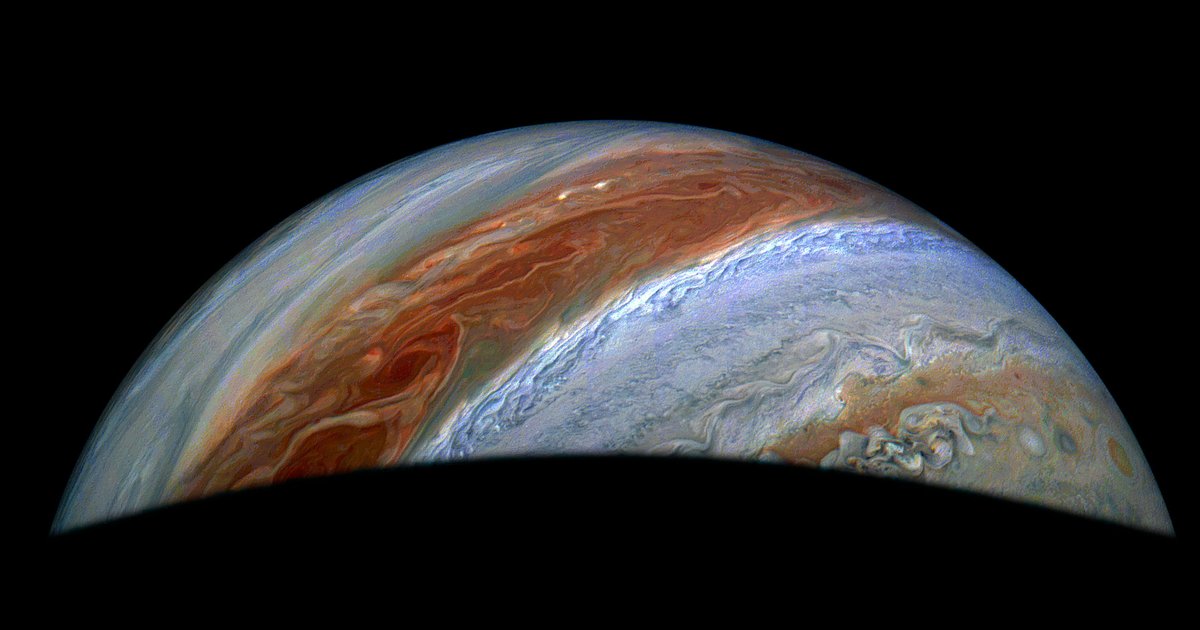
Researchers from Boston University have successfully mapped the upper atmosphere of Jupiter, revealing a stable structure that has remained relatively unchanged for many years. This discovery, published in the journal "Astrophysical Letters," promises to revolutionize our understanding not only of Jupiter but also of the behavior of atmospheres in the solar system.
For decades, speculation has surrounded the reasons behind Jupiter's weather patterns, but new observations reveal a phenomenon that is more consistent and sustainable than previously thought. The traditional view of Jupiter's atmosphere depicted chaos and unpredictability, but researcher Kate Roberts' team has presented a clearer and more organized picture.
Event Details
The research team was able to compile a global map of Jupiter's upper atmosphere, showing that temperature gradients across the planet's hemispheres are more stable than previously believed. This discovery dismantles decades of assumptions about the planet's weather fluctuations and offers a new model indicating that the poles are warmer than the equator, without random thermal explosions.
The researchers found that the temperature of Jupiter's atmosphere decreases smoothly from the poles towards the equator, ranging from 833 Kelvin (560 degrees Celsius) at the poles to 754 Kelvin (480 degrees Celsius) at the equator. This consistent pattern challenges previous theories that suggested chaotic thermal changes, providing a crucial tool for studying how heat is transferred and distributed on giant planets.
Background & Context
The discovery of a stable atmospheric system on Jupiter is significant in planetary science, demonstrating complex interactions between heat distribution and charged particle movement. This knowledge is not only essential for understanding Jupiter but extends to the atmospheres of other gas giants, including Earth.
This insight relates to the broader question of how atmospheres behave under extreme conditions, a vital understanding for future studies of exoplanets and planets within our solar system. If these patterns are applicable to other planets, scientists may be able to explain the strange atmospheric behaviors observed on exoplanets or gas giants like Saturn and Neptune.
Impact & Consequences
An image from the near-infrared camera of the James Webb Space Telescope revealed a high-speed jet stream extending over Jupiter's equator, highlighting the role that winds play in the upper atmosphere. Unlike Earth, where air currents drive most weather, Jupiter's upper atmosphere is shaped by planet-wide winds directing charged gases.
These winds are crucial in maintaining the apparent stability in the new maps, controlling the brightness patterns observed in infrared light across the planet. This discovery helps solve a long-standing mystery regarding the glowing lines in Jupiter's atmosphere, which were previously thought to be heat-related but are now understood to be linked to the density of charged particles.
Regional Significance
These discoveries enhance the importance of scientific research in the Arab region, inspiring new generations of scientists and researchers. Understanding planetary atmospheres can contribute to the development of new technologies in climate and environmental fields, positively impacting Arab communities.
In conclusion, this discovery represents a significant step towards a deeper understanding of the universe and underscores the importance of scientific research in space, opening new horizons for exploring the many secrets that space holds.