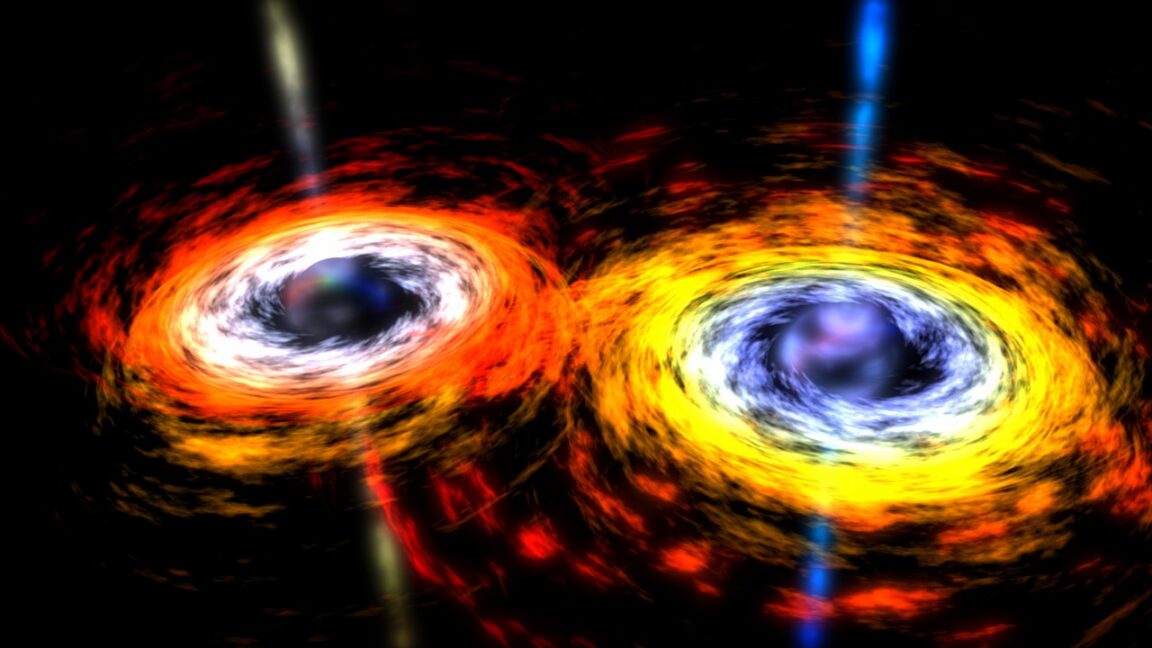
Astronomers have made an exciting discovery regarding giant star explosions, revealing that pair-instability supernovae lead to the creation of what is known as a "mass gap" in black holes. These findings enhance scientific understanding of how black holes form and their effects on stellar evolution in the universe.
Pair-instability supernovae are considered rare cosmic phenomena, occurring when a star's mass exceeds a certain threshold, resulting in a massive explosion that completely destroys the star. This type of explosion contributes to the formation of black holes, but the new discovery indicates that there is a mass gap between the black holes formed from these explosions.
Details of the Event
Black holes typically form from stars that exceed approximately 20 times the mass of the Sun. However, the black holes formed as a result of pair-instability supernovae are usually either less than or more than this mass, creating a gap in the mass distribution. This discovery is considered a significant step in understanding how black holes form and how they influence their surrounding environment.
Research has shown that black holes formed from pair-instability supernovae are less common than previously thought, opening the door for further studies on how these phenomena affect the evolution of stars and galaxies. Additionally, this discovery may help explain some cosmic phenomena that scientists have struggled to understand in the past.
Background & Context
Historically, black holes have been a controversial topic in astronomy. Over the decades, scientists have conducted numerous studies to understand how black holes form and their role in the universe. Pair-instability supernovae are among the most intriguing phenomena, believed to play a key role in the formation of massive black holes.
Research on black holes dates back to the 20th century, when scientists began to grasp the nature of these mysterious phenomena. With advancements in technology, astronomers have been able to observe more cosmic explosions, aiding in the development of theories regarding how black holes are formed.
Impact & Consequences
This discovery is significant as it opens new avenues for understanding how black holes form and their impact on stellar evolution. This new understanding may help explain certain cosmic phenomena, such as the distribution and formation of stars in galaxies.
Moreover, this discovery could influence future research in the field of astronomy, serving as a reference for understanding more cosmic phenomena. Understanding how black holes form can also aid in developing more accurate models to explain the evolution of the universe.
Regional Significance
Although this discovery may seem distant from the Arab region, understanding cosmic phenomena can have indirect effects on scientific research in the area. This discovery may encourage Arab scientists to engage in astronomical and astrophysical research, enhancing the region's standing in the field of science.
Furthermore, promoting scientific understanding of the universe can contribute to the development of educational and research programs in Arab universities, helping to prepare a new generation of scientists and researchers in this field.