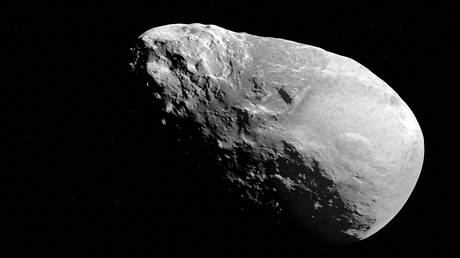
A team of scientists has made an astonishing discovery regarding asteroid Bennu, showing that the essential components within this asteroid are not distributed evenly as previously thought. This discovery raises new questions about how planets and celestial bodies form.
Asteroids like Bennu are celestial objects that contribute to our understanding of the history of the solar system. Previous studies have been conducted on asteroid Bennu, but this recent discovery highlights new details that could impact current theories about planetary formation.
Details of the Discovery
The asteroid Bennu was studied by NASA's OSIRIS-REx spacecraft, which was launched in 2016. The spacecraft successfully collected samples from the surface of the asteroid in 2020 and returned to Earth in 2023. During the analysis of these samples, scientists discovered that the chemical elements and minerals within the asteroid are not evenly distributed, indicating that complex geological processes may have occurred over time.
This discovery reflects the importance of ongoing research in space, as it can provide us with valuable information about how planets and other celestial bodies form. Understanding the distribution of materials within the asteroid can also help determine how those materials influence planetary development.
Background & Context
Asteroid Bennu is one of the near-Earth asteroids and is considered a primary target for scientific research due to its unique composition. It is believed that Bennu contains ancient materials dating back to the early solar system, making it a treasure trove of information about the history of the universe.
Historically, research on asteroids has focused on understanding how the solar system formed. Previous studies have shown that asteroids can be remnants of materials that did not coalesce into planets. However, the recent discovery in Bennu adds a new dimension to this understanding, suggesting that internal processes may be more complex than previously believed.
Impact & Consequences
This discovery could have significant implications for how we understand planetary formation. If the essential components within asteroids are not evenly distributed, it may mean that the processes leading to planet formation are more complex and varied than we thought. This could lead to a reevaluation of current theories regarding how planets and celestial bodies form.
Moreover, this discovery may influence future research in the field of space, encouraging scientists to study other asteroids more deeply to understand more about their formation and characteristics. Additionally, understanding planetary formation can have implications for the search for life beyond Earth.
Regional Significance
As the Arab region experiences increasing interest in science and technology, discoveries like this can have a positive impact on scientific research in Arab countries. Such discoveries can encourage the investment of more resources into scientific research and enhance cooperation among Arab nations in the fields of space and science.
Furthermore, enhancing scientific understanding in the region can contribute to the development of advanced educational programs, helping to prepare a new generation of scientists and researchers in the fields of space and natural sciences.