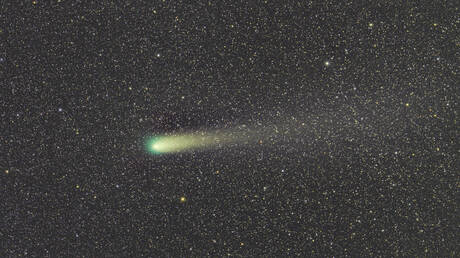
Scientists have reported that the comet 3I/ATLAS, which has garnered global interest, may be between 10 and 12 billion years old, indicating it formed shortly after the birth of the Milky Way galaxy. This discovery opens new horizons for understanding the history of the universe and the evolution of celestial bodies.
The comet 3I/ATLAS is considered one of the rare celestial bodies observed, attracting the attention of astronomers and space enthusiasts alike. Scientists indicate that this comet may hold valuable information about the conditions that prevailed in the universe during its early stages, helping to explain how planets and stars formed.
Details of the Discovery
The comet 3I/ATLAS was discovered in 2019, and since then, it has become the subject of intensive research and study. Estimates suggest that this comet may be remnants of the nebula from which the Milky Way galaxy formed, making it a window into the distant past of the universe.
This discovery is part of scientists' efforts to understand how celestial bodies form, as studying comets provides information about the primordial materials that contributed to planet formation. Comets are also considered time capsules, containing traces from ancient epochs.
Background & Context
Historically, comets were regarded as harbingers of doom in ancient cultures, but with the advancement of science, they are now viewed as valuable tools for studying space. In recent years, discoveries related to comets have increased, contributing to the expansion of our knowledge about how the universe evolves.
The interest in comets dates back to ancient times when they were seen as signs of major events. However, modern understanding of comets has significantly evolved, as they are now considered key components in the study of space and astronomy.
Impact & Consequences
The discovery of the age of comet 3I/ATLAS could impact various fields of scientific research, including astronomy and planetary science. This finding may help clarify how planets and stars form, contributing to a deeper understanding of the history of the universe.
Moreover, this discovery could pave the way for further studies on other comets, potentially leading to new discoveries about the formation of the solar system. This finding enhances the importance of comets as tools for studying space.
Regional Significance
Astronomical studies are an important part of the scientific culture in the Arab world, contributing to a broader understanding of the universe. This discovery could encourage more investments in scientific research in Arab countries, contributing to the development of scientific knowledge.
Furthermore, enhancing interest in astronomy in the region could lead to increased awareness of the importance of science and technology, contributing to the development of Arab societies and enhancing their standing in the global scientific arena.