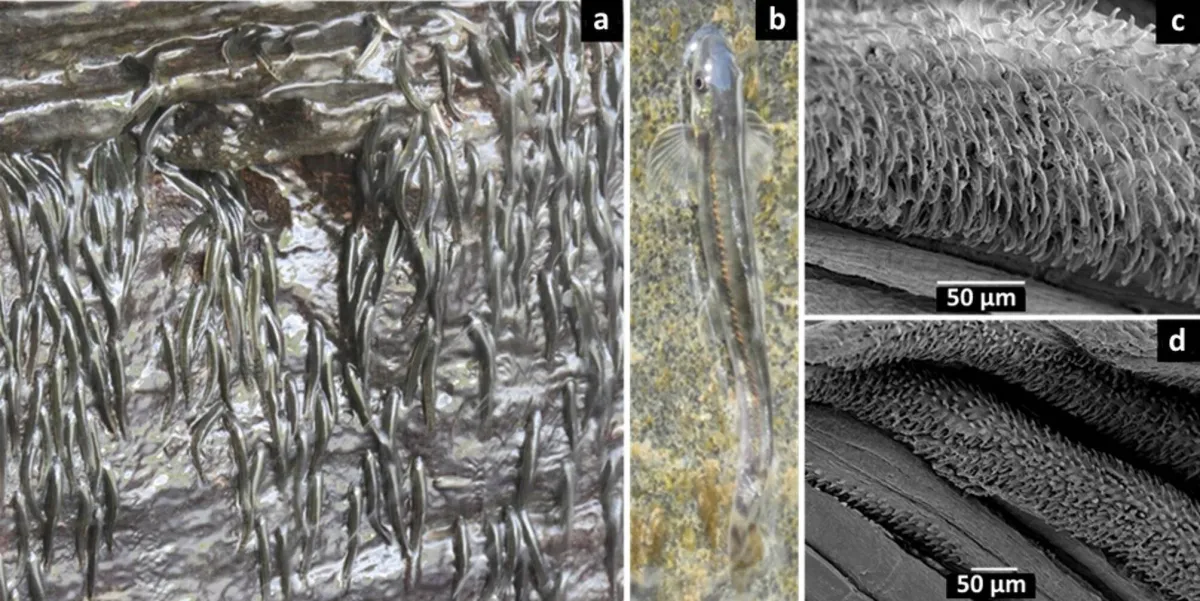
After decades of rumors and questions, the climbing behavior of the Schilbe fish, scientifically known as Parachanna thysi, has finally been documented at the Lovilombo waterfalls in the Democratic Republic of Congo. These small fish, measuring between 37 and 48 millimeters in length, have demonstrated an incredible ability to climb waterfalls that rise 15 meters high, a feat that was considered mere legend in the minds of Central African inhabitants.
The study, conducted by researcher Pacific Kiweli Mutambala and his team from the University of Lubumbashi, spanned from 2018 to 2020, during which the climbing journey of these fish was documented across the Lovilombo waterfalls. The results showed that these fish migrate upstream, clinging to wet rock surfaces, in a journey that takes about 10 hours, interspersed with rest periods.
Details of the Climbing Behavior
The climbing behavior of the Schilbe fish is unique, with thousands of fish observed making their way to the top, overcoming the challenges of rushing waters. According to the study, the fish require frequent rest periods, with 9 main horizontal ledges identified where the fish rest, making the total climbing time reach 9 hours and 45 minutes. However, not all fish succeed in completing the journey, as some were observed falling due to sudden water surges.
The ability of these fish to climb is attributed to small hook-like protrusions on their fins, which help them grip the rocks. Interestingly, smaller fish, measuring less than 48 millimeters, are the most capable climbers, while larger fish appear to be less adept at this behavior.
Background & Context
This phenomenon is rare, typically recorded during the flooding period at the end of the rainy season, specifically in the months of April and May each year. Although the purpose of this behavior remains somewhat unclear, hypotheses suggest that the fish may be swept from their habitats upstream during heavy rains and are attempting to return. It is also possible that these fish are seeking areas with less competition for food.
This phenomenon also shows similar behaviors in other fish species, opening the door for future studies on how living organisms adapt to their changing environments.
Impact & Consequences
This study represents a significant step in understanding fish behavior and their ability to adapt to harsh environments. It also highlights the importance of scientific research in documenting natural phenomena that may seem strange or unbelievable. By documenting this phenomenon, scientists can gain new insights into biodiversity and adaptation in aquatic environments.
These findings also serve as evidence of the importance of preserving natural habitats, as environmental changes can affect the behavior of living organisms and their survival capabilities. Thus, understanding these phenomena may aid in developing strategies to conserve biodiversity in aquatic regions.
Regional Significance
Although this phenomenon pertains to living organisms in Central Africa, it has broader implications for understanding biodiversity in the Arab world. Many ecosystems in the region face similar challenges due to climate change and pollution. Therefore, studying the behavior of living organisms in different environments can provide valuable lessons on how to address environmental challenges.
In conclusion, this phenomenon remains an example of nature's ability to amaze us and underscores the importance of scientific research in understanding the world around us. Documenting these phenomena helps enhance environmental awareness and encourages further studies on biodiversity.