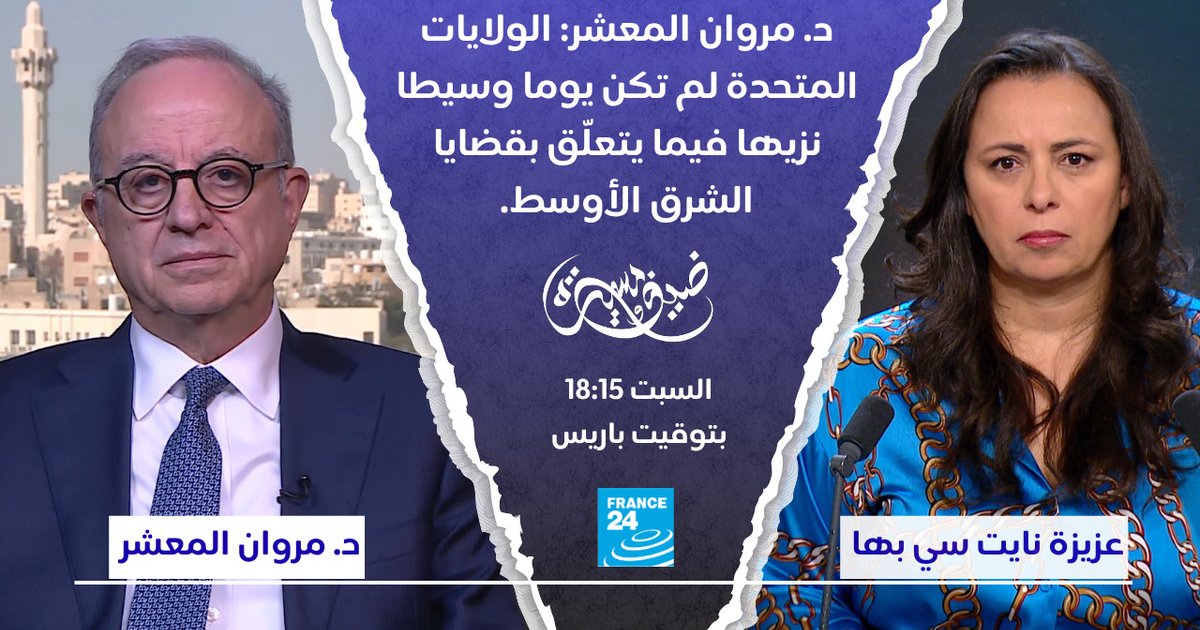
Former Jordanian Foreign Minister, Dr. Marwan Muasher, asserted that the United States has never been a fair mediator in the Arab-Israeli conflict, pointing out that Israeli military dominance enjoys full American support. This was stated during his interview on the program 'Guest and Journey', where Muasher reviewed pivotal moments in his life and diplomatic experience.
Muasher began his discussion by reflecting on his family roots connected to the Palestinian cause, noting that his mother was displaced from Jaffa in 1948 and moved to Amman. This background led him to grow up in an environment that carries the Palestinian cause in memory and sentiment. He emphasized that this connection is not exclusive to Palestinians but encompasses all Jordanians, as the Palestinian issue remains part of the Jordanian national consciousness.
Details of the Event
Muasher spoke about his years of study in the United States, where he obtained advanced degrees in engineering and computer engineering. However, he did not separate his academic experience from his perspective on American politics in the Middle East. He considered that Washington has never been a neutral mediator but rather a biased party towards Israel, leading to a clear Israeli military dominance in the region.
He also criticized the American policy that attempted to bypass the Palestinian issue through the Abraham Accords, indicating that these agreements did not address the core of the conflict but prioritized normalization while ignoring Palestinian rights. He confirmed that the events of October 7 and the subsequent war revealed the fragility of this narrative.
Context and Background
Muasher also reviewed milestones in his political career, starting from his transition from engineering to public work, where he considered the events of 1989 in Jordan to be a turning point in the state's recognition of the importance of political reform. He discussed his experience as the director of the Jordanian media office in Washington before the Gulf War, where he learned how to address the Western media in a language they understand.
He touched upon the details of the Madrid negotiations, clarifying that Jordan did not enter this process alone but within an Arab framework. However, the path faltered with the signing of the Oslo Agreement. He affirmed that Jordan's signing of the peace treaty with Israel was a step to protect Jordanian borders and prevent any Palestinian displacement.
Consequences and Impact
Muasher spoke about the attempted assassination of Khaled Mashal in Amman in 1997, which served as a test of Israel's seriousness in respecting the peace treaty. He emphasized that Jordan did not view peace as a political surrender but as an agreement tied to clear national interests.
He also discussed his experience as Jordan's ambassador to Israel, where he confirmed that his aim was to defend Jordanian interests, not to serve Israeli interests. He noted that his understanding of the Israeli mindset made him more critical of their expansionist project.
Impact on the Arab Region
In closing, Muasher stressed the importance of political reform as a condition for the future of the region, indicating that Arab countries rely on economic models that are no longer viable. He considered the absence of an Arab project in contrast to the clarity of the Israeli project to be a significant challenge, asserting that any serious Arab project cannot be established without genuine internal reform.
He pointed out that Saudi Arabia plays an important leadership role in the region through its clear stance on normalization, which requires the establishment of a Palestinian state. He regarded this position as deserving of support, as it provides a focal point for a broader Arab alliance at a time when the region suffers from fragmentation.