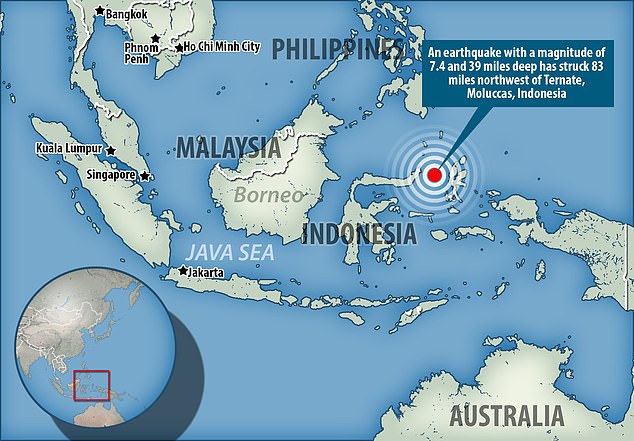
The Indonesian Meteorology, Climatology, and Geophysics Agency (BMKG) has announced the official end of the tsunami warning that followed the strong earthquake that hit the northern Maluku and North Sulawesi regions, which registered a magnitude of 7.6 on the Richter scale. This announcement was made during a press conference held in Jakarta, where the agency's head, Dwikorita Karnawati, confirmed that maritime conditions have stabilized after monitoring the sea conditions.
Karnawati explained that the tsunami warning, which was issued after the earthquake, officially ended at 09:56 local time in Indonesia. She emphasized that this announcement is a significant step, as it will allow emergency teams to enter the areas affected by the earthquake and tsunami.
Details of the Earthquake Event
The earthquake occurred at a depth of 33 kilometers beneath the sea surface, with its epicenter located 129 kilometers southeast of the city of Bitung in North Sulawesi. This earthquake caused strong tremors in several areas, including Ternate in northern Maluku, where intensities reached V-VI MMI, while the intensity in Manado was recorded at IV-V MMI.
Following the earthquake, the agency issued warnings regarding the possibility of a tsunami in areas such as Ternate, Halmahera, and Bitung, with additional warnings in other parts of North Sulawesi. Small tsunami waves were observed, with heights recorded at approximately 0.3 meters in Halmahera and 0.2 meters in Bitung.
Background & Context
Indonesia is considered one of the most earthquake- and tsunami-prone countries due to its location on the Pacific Ring of Fire, where several tectonic plates converge. Historically, the country has experienced numerous devastating earthquakes, including the earthquake and tsunami that occurred in 2004 in Sumatra, which resulted in the deaths of hundreds of thousands.
Concerns about earthquakes in Indonesia are increasing, particularly in coastal areas that suffer from weak infrastructure. Therefore, early warnings and coordination among government agencies are vital to mitigate potential damage.
Impact & Consequences
Despite the end of the tsunami warning, BMKG has warned residents to remain alert for the possibility of aftershocks. So far, 40 aftershocks have been recorded, the strongest of which measured 5.5 on the Richter scale.
These warnings are essential for protecting lives and property, as aftershocks can have serious effects on the affected areas. Additionally, a swift response from emergency teams will help assess the damage and provide necessary assistance to the affected populations.
Regional Significance
While earthquakes in Indonesia may seem distant from the Arab region, such natural events remind us of the importance of preparedness for natural disasters. Many Arab countries, especially those located along coastlines, must be ready to face similar threats.
International cooperation in sharing information about earthquakes and tsunamis can contribute to enhancing rapid response and reducing potential damages.