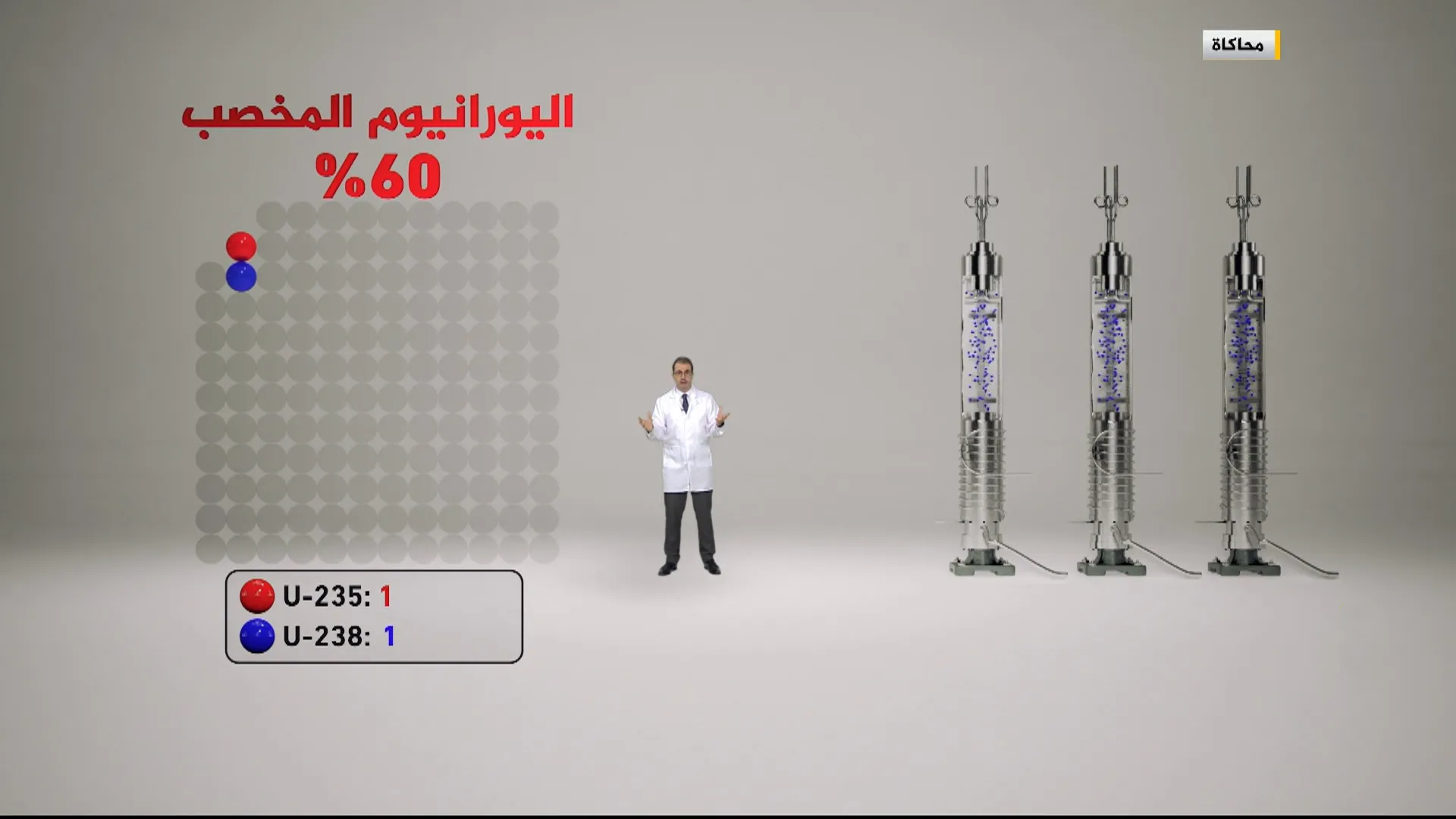
Iran's possession of 60% enriched uranium marks a critical turning point in its nuclear trajectory. Experts reveal that this level indicates Iran is very close to producing a nuclear bomb, raising international concerns.
In the world of politics, numbers seem logical and incremental, but in the realm of nuclear physics, they can be misleading. Many believe that transitioning from 60% uranium enrichment to 90%—the required level for nuclear bomb production—takes a long time and significant effort. However, scientific reality shows that Iran is just one step away from achieving this goal, a step that is considered the easiest and fastest.
Details of the Situation
Scientific facts reveal that centrifuges show the opposite of what many believe. The distance between a peaceful reactor and a nuclear bomb may not exceed the removal of just one ball of fissile uranium. Mahmoud Al-Khan explains in his report for Al Jazeera that raw uranium contains 143 balls, of which 142 are blue (non-usable) and one is red (fissile and usable for bomb-making).
Producing a nuclear bomb requires approximately 38 kilograms of 60% enriched uranium. With Iran currently possessing around 440 kilograms, it is theoretically capable of producing 10 nuclear bombs in a short timeframe.
Background & Context
This precise reverse engineering explains the reason behind the stringent American demands towards Iran. Washington is not only unwilling to compromise on reducing enrichment levels but is also demanding the complete elimination of stockpiles, meaning dismantling the enrichment chain from its roots and preventing Iran from ever reaching 60% enrichment. Additionally, it calls for freezing enrichment by removing centrifuges, which are considered the main engine for atom separation.
Iran's stockpile of highly enriched uranium, which amounts to around 440 kilograms at 60%, is the most sensitive negotiating point. The U.S. administration insists on the necessity of removing this stockpile from Iran, and former President Donald Trump suggested transferring it to U.S. territory or a third party like Russia.
Impact & Consequences
Iran faces increasing international pressure regarding its nuclear program, as Tehran firmly rejects American demands, asserting that transferring uranium abroad is unacceptable. This resistance raises the stakes in the ongoing negotiations and could lead to heightened tensions in the region.
The implications of Iran's nuclear advancements extend beyond its borders, potentially destabilizing the entire Middle East. Countries in the region are closely monitoring Iran's actions, fearing a nuclear arms race that could ensue if Iran successfully develops nuclear weapons.
Regional Significance
The situation is particularly significant for neighboring countries, which are already grappling with security challenges. The prospect of a nuclear-armed Iran could compel these nations to reconsider their defense strategies and seek their own nuclear capabilities as a countermeasure.
In conclusion, Iran's advancements in uranium enrichment not only pose a direct challenge to international norms but also threaten to reshape the security landscape of the Middle East. The international community must address these developments with urgency to prevent further escalation.