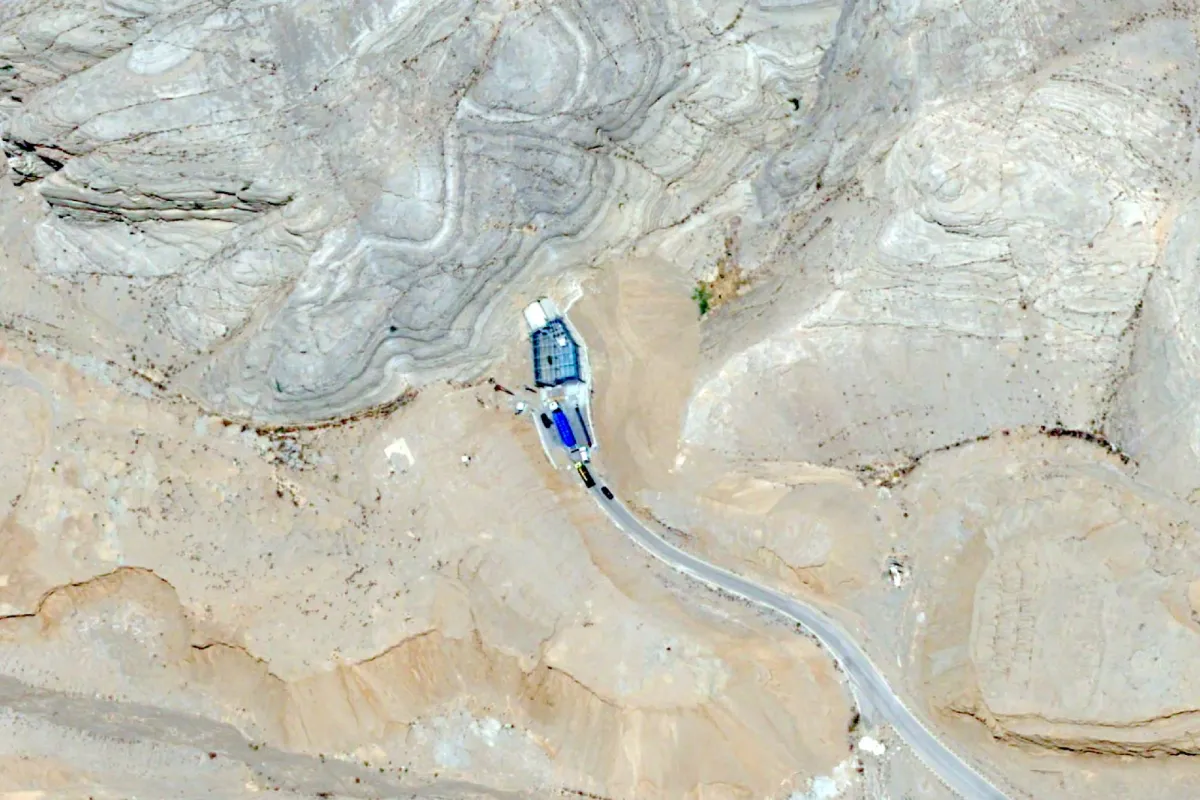
Experts and former U.S. officials have cautioned that any attempt to secure Iran's enriched uranium stockpile by force would be a highly complex and risky operation. As discussions in Washington grow regarding President Donald Trump's administration's willingness to go far down this path, whether through military threats or pressure to surrender nuclear materials as part of a negotiated settlement.
Trump has provided varying justifications for a war on Iran, but he has maintained a consistent primary goal: to ensure that Tehran never possesses a "nuclear weapon." However, it remains unclear how far he is willing to go to control Iran's nuclear materials, according to the Associated Press.
Details of the Situation
Estimates suggest that the option of using force to remove these materials from Iran would require the deployment of up to 1,000 specially trained personnel into a war zone, which involves radiation, chemical, and military risks. Data shows that Iran possesses 440.9 kilograms of uranium enriched to 60 percent, just a technical step away from the 90 percent level used in weapons, according to the International Atomic Energy Agency (IAEA).
The IAEA's Director General, Rafael Grossi, stated that this stockpile could allow Iran to manufacture up to 10 nuclear bombs if it decides to convert its program to military use. Despite Tehran's insistence that its nuclear program is peaceful, the IAEA and Western nations indicate that Iran was managing an organized nuclear weapons program until 2003.
Background & Context
Iran's nuclear materials are distributed within tunnels and underground storage facilities, with the absence of direct verification capabilities since June 2025. Israeli and U.S. strikes have weakened Iran's air defenses, making it more challenging to locate these materials. Grossi believes that a stockpile of nearly 200 kilograms of highly enriched uranium is stored in tunnels within the Iranian nuclear complex outside Isfahan.
He also noted that additional quantities may exist at the Natanz facility, and possibly smaller amounts at the Fordow facility, with an unresolved possibility of additional materials at other sites. In Washington, the U.S. Director of National Intelligence confirmed that the intelligence community has a "high confidence" in knowing the locations of Iran's highly enriched uranium stockpiles.
Impact & Consequences
Any military operation to secure Iran's nuclear materials would require complex coordination between special forces and nuclear experts, increasing the likelihood of human casualties. Kristine E. Wormuth, former U.S. Secretary of the Army, warned that securing these materials would be a complex and high-risk military operation, as the materials could be located at multiple sites.
In this context, the best option from the perspective of some experts is to reach an agreement with the Iranian government to remove all nuclear materials, recalling a previous process that occurred in 1994. However, Tehran remains wary of Washington, which withdrew from the nuclear agreement during Trump's administration.
Regional Significance
Concerns are rising in the region over escalating tensions due to the Iranian nuclear program, as any military operation against Iran could destabilize the entire region. Additionally, any escalation in conflict could affect relations between Arab states and Iran, complicating security situations in the Middle East.
In conclusion, the future of Iran's nuclear program and its enriched uranium stockpile remains a contentious issue that requires an effective diplomatic solution, as military options could lead to dire consequences.