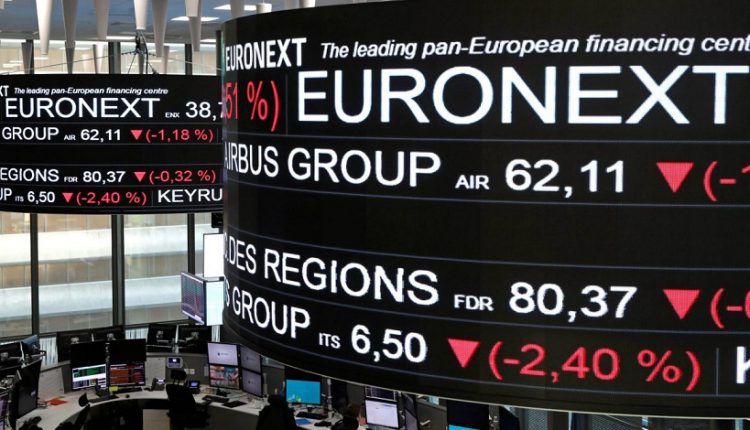
European stock indices exhibited mixed performance at the start of trading on Monday, influenced by the stalled US-Iran peace talks affecting investor confidence. This comes as markets await crucial decisions from the world's major central banks.
The European index “Stoxx Europe 600” remained stable at 611 points, reflecting a cautious sentiment in the markets. In contrast, the French index “CAC 40” recorded an increase of 0.3%, reaching 8181 points. The German index “DAX” also saw a rise of 0.35%, climbing to 24212 points, while the British index “FTSE 100” remained almost unchanged, trading at 10376 points.
Details of the Event
These movements in the European markets occur at a sensitive time, with growing concerns about the impact of geopolitical conditions on the global economy. The stalled peace talks between the United States and Iran could exacerbate economic crises, negatively affecting investor confidence. Additionally, rising oil prices due to regional events may increase inflationary pressures.
Markets are also anticipating the monetary policy meetings of the European Central Bank and the Bank of England next Thursday, following a day after the US Federal Reserve meeting. These meetings may carry signals regarding the potential for interest rate hikes, which could significantly impact financial markets.
Background & Context
Historically, European markets have experienced significant fluctuations due to political and economic events. These fluctuations reflect the extent to which European markets are tied to global events, particularly those related to the United States and the Middle East. In recent years, there have been several attempts to reach peace agreements, but they have often faced substantial obstacles.
The US-Iran peace talks are among the most pressing issues concerning investors, as any failure to reach an agreement could lead to escalated tensions, impacting oil prices and financial markets in general.
Impact & Consequences
The ongoing uncertainty in the markets may lead to greater price volatility, affecting investment decisions. Should oil prices continue to rise, this could increase inflationary pressures, prompting central banks to adopt more cautious monetary policies.
Moreover, any changes in monetary policy could influence foreign investment flows into European markets, potentially leading to a slowdown in economic growth in the region. Therefore, markets are closely monitoring any signals from central banks.
Regional Significance
Developments in European markets directly affect the Arab region, especially given the heavy reliance on oil and gas. Any increase in oil prices due to geopolitical events could have negative repercussions on Arab economies that depend on oil exports.
Furthermore, instability in European markets may lead to a decline in foreign investments in the region, which could impact economic growth in Arab countries. Therefore, Arab nations must closely monitor these developments.
In conclusion, European markets remain in a state of anticipation, with investors looking for any signals that may influence their decisions under current conditions. Understanding these dynamics is vital for any successful investment during these turbulent times.