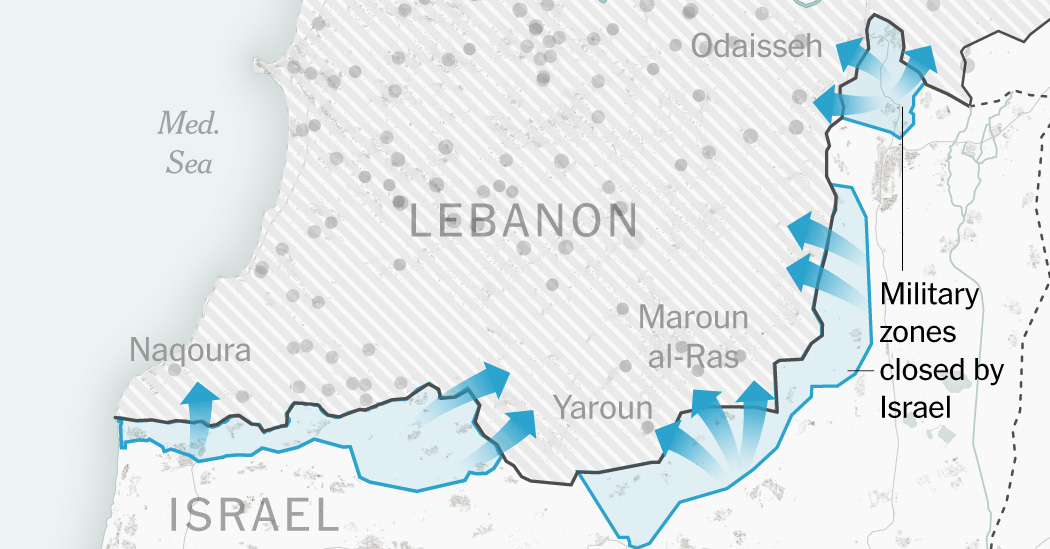
The military developments in southern Lebanon indicate that the Israeli occupation army is operating under a doctrine based on three parallel offensive axes, primarily aimed at expanding the buffer zone south of the Litani River. This expansion focuses on strategic points such as the Bayada triangle and its heights.
According to military expert Brigadier General Hassan Jouni, the main effort of the Israelis is concentrated towards Deir Siryan reaching the river, while a secondary attack is being executed on the coast to take advantage of naval support and the relative exposure of the area. The attack from the center aims to separate the eastern incursion path from the western, in line with the military doctrine of the stabilizing attack, as Brigadier General Jouni noted during the military analysis segment.
Details of the Event
On the ground, the Israeli army is gradually expanding its areas of control, attempting to reach strategic control points. However, the attack towards Deir Siryan indicates attempts to develop operations towards the river, according to the military expert's opinion. Brigadier General Jouni confirms that the ultimate goal north of the Litani is unrealistic due to the challenges of the Lebanese terrain and the destruction of key bridges that define the ceiling of the ground incursion, making southern Litani the maximum possible area for military deployment.
Earlier, a Lebanese military source reported to Al Jazeera that Israeli forces had reached one of the tributaries of the Litani River in the eastern sector. In contrast, the Lebanese resistance is following a balanced tactic to deal with the attack, allowing Hezbollah to partially let the Israeli army advance in certain directions to strike it from the flanks and rear, causing continuous losses to the invading forces.
Background & Context
Hezbollah fighters benefit from their anti-tank equipment, including missiles and drones equipped with hollow charge warheads, to target tanks from above or from their weak areas. This strategy limits the occupation's ability to establish advanced positions, as Brigadier General Jouni explains.
This dynamic allows Hezbollah to leverage the terrain and its long-standing field knowledge of southern Lebanon, granting it an advantage in maneuvering its forces and exhausting the invading troops without retreating. Hezbollah draws on its historical experience in confronting the Israeli occupation, including operations since 2006.
Impact & Consequences
Analyses show that both sides know the land and the enemy well. Israel avoids getting bogged down in the Lebanese quagmires and uncalculated advances, while Hezbollah continues its offensive defensive strategy that combines leveraging the terrain and inflicting losses on the invading forces and vehicles.
Israeli Defense Minister Israel Katz stated days ago that the army is determined to impose control over vast areas in southern Lebanon, reaching the Litani River, reflecting a trend towards expanding aggression. On March 2, Hezbollah launched missile and drone attacks on military sites and Israeli settlements in response to the assassination of former Iranian leader Ali Khamenei and the ongoing Israeli assaults on Lebanon despite the ceasefire agreement since November 2024.
Regional Significance
Concerns are rising over escalating tensions in the region, as these developments could lead to a greater escalation in the conflict between Hezbollah and Israel. The continuation of military operations may also affect stability in Lebanon and complicate humanitarian conditions.
In conclusion, the situation in southern Lebanon remains tense, with the Israeli occupation continuing its military escalation, while Hezbollah adopts counter-tactics aimed at protecting Lebanese territory and exhausting the invading forces.