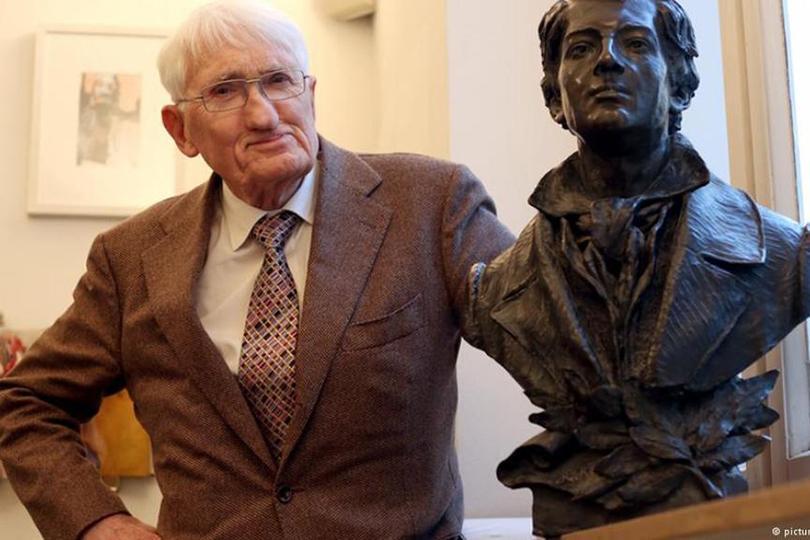
Jürgen Habermas is regarded as one of the foremost contemporary philosophers, not merely an academic thinker reflecting on existence from an ivory tower, but as an embodiment of the consciousness of late European rationality in its struggle with its own ghosts. Habermas has lived through a history filled with disappointments, striving to salvage what can be salvaged from the Enlightenment values that have eroded due to contemporary challenges.
Habermas's philosophy manifests in his quest to understand the contradictions facing rationality in the modern world. He was not only a philosopher but also a philosophical conscience bearing the weight of an entire history of disappointments, prompting him to pose profound questions about the future of human values amid social and political changes.
Event Details
Habermas's works illustrate how rationality, once representing hope for progress, has been tested in the face of global crises. He has witnessed the rise of totalitarian regimes, the disintegration of societies, and the widening social gaps, leading him to call for a rethinking of the foundations upon which the Enlightenment stands.
Habermas believes that dialogue and communication are key to understanding the challenges facing modern societies. He advocates for the necessity of building a public sphere where ideas can be exchanged freely, contributing to the enhancement of democracy and social justice. He has pointed out that philosophy must transcend academic boundaries to serve as a tool for social change.
Background & Context
Historically, Habermas has lived through a period marked by radical transformations in European thought, beginning with World War II and the subsequent conflicts. This era was filled with challenges that impacted the trajectory of philosophy and science, prompting Habermas to contemplate how to restore human values amid chaos.
Habermas's ideas were influenced by many previous philosophers, such as Immanuel Kant, whom he regarded as a fundamental reference in his philosophy. He was also influenced by the critical school of thought, which sought to understand the relationship between society and culture, contributing to the formation of his philosophical vision.
Impact & Consequences
Habermas's ideas have a significant impact across multiple fields, from philosophy and politics to sociology. His vision regarding the importance of dialogue and communication has shaped many social and political movements striving for justice and equality.
Moreover, his philosophy opens new horizons for understanding contemporary challenges, calling for a rethinking of how to build more democratic and tolerant societies. His call for dialogue reflects the importance of understanding among different cultures in a diverse and complex world.
Regional Significance
In the Arab context, Habermas's ideas can be considered an important reference for understanding the challenges facing Arab societies in the age of globalization. With the increase in political and social crises, the need for open dialogue emerges as a means to build more stable and cohesive communities.
The current conditions in the Arab region require a rethinking of human values, making Habermas's philosophy highly relevant. Dialogue and communication can serve as effective tools in addressing the challenges faced by Arab societies, especially amid ongoing conflicts.
In conclusion, Jürgen Habermas stands as a symbol of contemporary philosophical thought, demonstrating how philosophy can be a tool for social change. His call for dialogue and communication represents an urgent invitation for Arab societies to reflect on their future and build a better world.