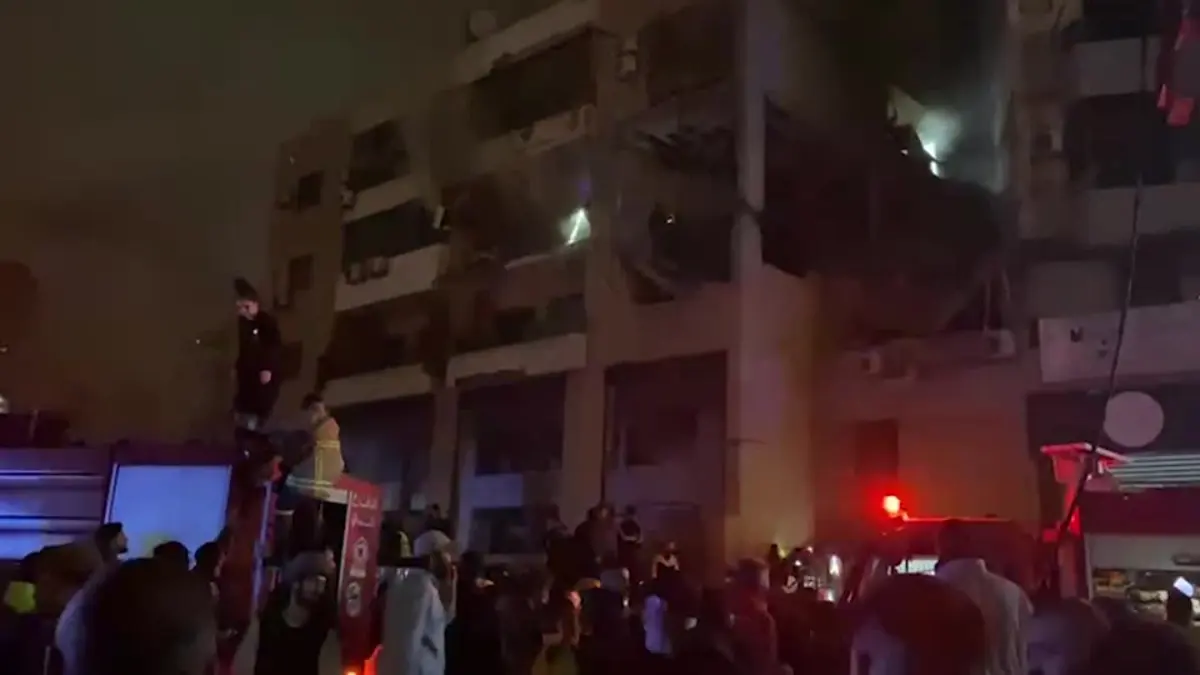
Powerful explosions were heard in the Lebanese capital, Beirut, on Saturday, as the Israeli army announced the commencement of airstrikes targeting what it described as "Hezbollah's infrastructure" in the southern suburb. A reporter from Agence France-Presse in Beirut reported hearing at least two explosions within half an hour, noting that one was followed by a thick plume of smoke.
The Israeli army confirmed via its official Telegram account that it had begun military operations targeting Hezbollah sites, as part of escalating tensions between the two sides. This escalation comes at a time when the region is witnessing increasing tensions, raising fears among civilians in Beirut and surrounding areas.
Details of the Incident
The explosions heard in Beirut come at a sensitive time, with fears of a larger military escalation in the region. Initial images showed smoke rising from areas near the southern suburb, which is considered a stronghold for Hezbollah. This escalation follows a series of tensions between Israel and Hezbollah, with both sides exchanging accusations of inciting violence.
It is noteworthy that Hezbollah had previously announced its readiness to respond to any Israeli aggression, further heightening tensions in the region. Analysts have indicated that this escalation could lead to serious repercussions for regional security, especially given the tense political situation in Lebanon.
Background & Context
Historically, the relationship between Israel and Hezbollah has been marked by ongoing tensions, with several rounds of conflict between the two parties, the most notable being the 2006 war. Since then, Hezbollah has continued to enhance its military capabilities, making the southern suburb a strategic area for the group.
In recent years, Israeli military activities against Hezbollah have increased, as Israel seeks to prevent the group from bolstering its military capabilities, especially in light of Iranian support for Hezbollah. This historical context complicates current events, as regional and international interests intersect in the conflict.
Impact & Consequences
The recent escalation could lead to serious repercussions for security in Lebanon, where citizens live in a state of anxiety and anticipation. These events may affect political stability in the country, particularly amid the economic and social crises that Lebanon is experiencing.
Moreover, the escalation may impact relations between Lebanon and other Arab countries, as some nations may intervene in an attempt to calm the situation. At the same time, this escalation could increase international support for Hezbollah, further complicating the situation.
Regional Significance
The events in Lebanon have direct implications for security and stability in the Arab region as a whole. The tensions between Israel and Hezbollah could lead to military escalation that may extend to neighboring countries, increasing instability in the region.
These events may also affect peace efforts in the region, as some countries seek to achieve political settlements. Under these circumstances, citizens in Lebanon and neighboring countries remain in a state of anxiety and anticipation, complicating the regional landscape further.
The recent escalation in Beirut reflects a state of ongoing tension between Israel and Hezbollah, raising concerns about security and stability in the region. Under these circumstances, hope remains pinned on peace efforts and dialogue to avoid further escalation.