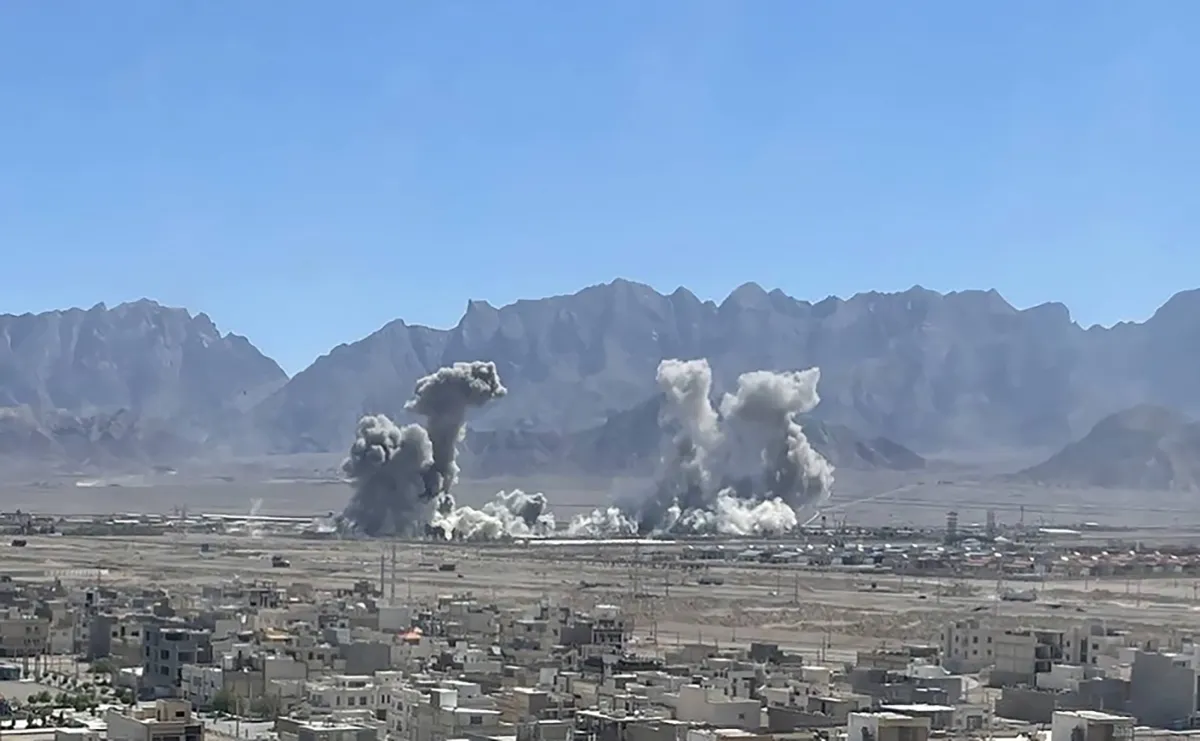
Explosions were heard in Tehran, leading to power outages in some parts of the capital, according to Iranian media reports today (Tuesday). This development comes after more than a month of escalating conflict in the Middle East, triggered by U.S.-Israeli attacks on Iran.
Fars News Agency reported power outages in parts of Tehran following multiple explosions. Tasnim News Agency also mentioned that some residents in eastern and western Tehran experienced electricity cuts, with authorities working to restore service, confirming damage to a substation linked to a power plant, according to Agence France-Presse.
Details of the Incident
Preliminary investigations revealed that the airstrikes in central Iran targeted several military sites, although their exact locations have not been precisely identified. Fars News Agency quoted the security official in the Isfahan governor's office, Akbar Salehi, stating that "initial investigations indicate the targeting of some military sites in Isfahan," noting that the extent of damage and casualties is still unclear.
In a related context, the Iranian news agency (IRNA) reported that three individuals were killed due to a U.S.-Israeli airstrike targeting a religious complex and shrine in the city of Zanjan in the northwest of the country early this morning. The attack also resulted in injuries to several people and caused damage to multiple buildings within the complex.
Background & Context
The Iranian leadership is experiencing unprecedented confusion and division amid a four-week ongoing war with the United States and Israel, which has resulted in the deaths of numerous leaders and senior officials. This situation has weakened the government's ability to make decisions and coordinate retaliatory strikes, according to assessments from U.S. and Western intelligence.
Officials indicated that surviving leaders are facing significant communication difficulties, hindering direct meetings and leading to a relative paralysis in the decision-making process. Despite the continued operation of security and military agencies, the government's capacity to formulate new policies or plan large-scale attacks has significantly diminished.
Impact & Consequences
Reports suggest that hardliners within the "Revolutionary Guard" have become more influential, complicating the political landscape in Iran. The Israeli airstrikes targeting the Iranian leadership resulted in the death of Iranian Supreme Leader Ali Khamenei and a significant number of national security leaders, leading to chaos within the Iranian leadership.
U.S. President Donald Trump has threatened to escalate the war if a swift agreement is not reached, indicating the possibility of targeting vital facilities such as energy centers and infrastructure. This escalation reflects a state of instability in the region and complicates negotiation opportunities between Iran and the United States.
Regional Significance
The Arab region is significantly affected by the rising tensions between Iran and the United States and Israel, with increasing fears of the conflict expanding. Neighboring Arab countries are closely monitoring the situation, as any escalation could lead to major security and economic repercussions.
Under these circumstances, the future of the conflict remains open to possibilities of escalation or de-escalation, further complicating the regional landscape and leaving the peoples of the region in a state of anxiety and anticipation.