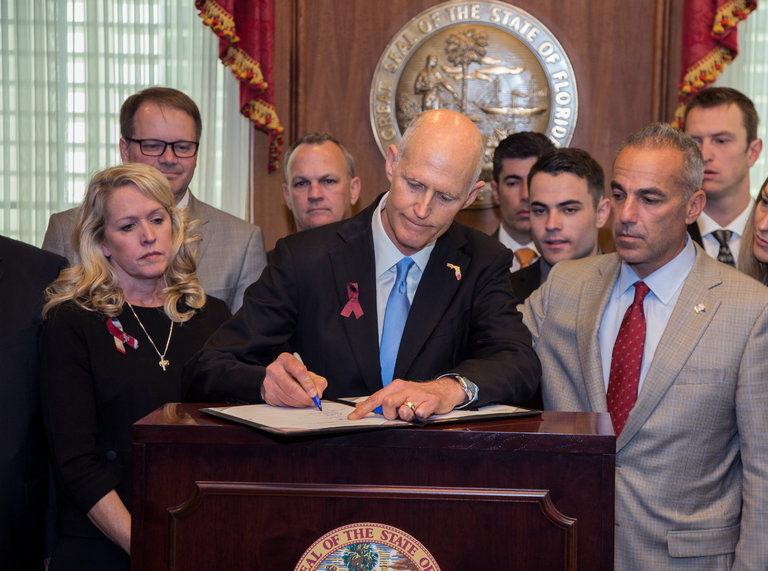
Florida Governor Ron DeSantis has signed a new law that permits authorities to classify individuals as terrorists, sparking widespread debate over the law's impact on free speech and legal rights. This legislation was enacted at a time when discussions are intensifying regarding how to address security threats in the United States.
The new law, recently signed, aims to enhance the authorities' ability to combat terrorism, but it has raised concerns about the potential misuse against individuals expressing political or social views that may be deemed inconsistent with official positions. Many human rights advocates have expressed worry that this law could be used as a tool to suppress dissent.
Details of the Legislation
The law includes mechanisms for classifying individuals as terrorists based on specific activities, allowing authorities to take legal action against them. This legislation has been presented as part of the governor's efforts to tackle what are perceived as increasing threats to public safety. However, criticisms have focused on the lack of clarity regarding the criteria used for this classification, leaving ample room for personal interpretation.
There are also concerns that this law could restrict free speech, as it may be used against individuals who openly express their opinions. Some experts have pointed out that such laws can create a climate of fear among citizens, negatively affecting public discourse.
Background & Context
Historically, the United States has seen numerous laws aimed at combating terrorism, but these laws have often been contentious. In recent years, there has been growing concern over the use of laws to monitor individuals and suppress dissenting opinions. This new law raises questions about how to balance security with individual rights.
This move comes at a time when the world is witnessing a rise in protest movements, as many individuals seek to express their views on political and social issues. In this context, the new law poses a significant challenge to civil rights in the United States.
Impact & Consequences
This law could have far-reaching effects on American society. While policymakers aim to enhance security, laws that restrict free speech may lead to backlash. Citizens may feel apprehensive about expressing their opinions, potentially resulting in decreased political participation.
Moreover, this law could be utilized as a justification for human rights violations, complicating the legal status of individuals. Under these circumstances, it becomes essential to monitor the implementation of this law closely to ensure it is not used unfairly.
Regional Significance
While this law focuses on domestic issues in the United States, it could have implications that reach the Arab region. Developments in the United States often influence foreign policies, and such laws may be used as a pretext to justify repressive measures in other countries.
Furthermore, discussions surrounding free speech and human rights are particularly significant in the Arab world, where many countries are striving to enhance the rights of their citizens. Therefore, monitoring the developments of this law in the United States could have repercussions for human rights movements in the region.