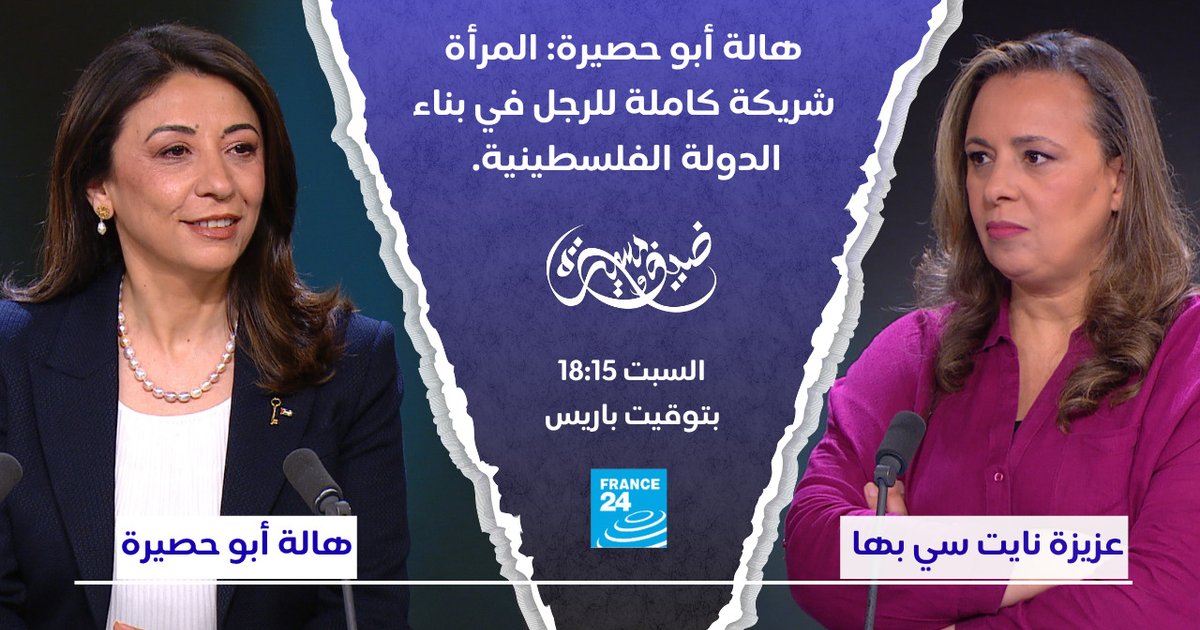
In a new episode of the program "Guest and Journey," we hosted Ambassador Hala Abu Hasira, who presented her credentials as the first ambassador of the State of Palestine in France on March 25, 2026. In an extensive interview, Abu Hasira reviewed her personal and professional journey, pointing out the importance of diplomacy in conveying the voice of the Palestinian people to the world.
The ambassador believes that France's recognition of Palestine on September 22, 2025, was not merely a diplomatic procedure, but represents a historic moment in the history of the Palestinian struggle. She states: "The recognition was a very significant historical moment in the history of the Palestinian struggle and the Palestinian cause. France made the right decision, which certainly came late, but it arrived at a crucial historical moment for the Palestinian people who are subjected to the most heinous crimes."
Details of the Event
Abu Hasira confirms that this recognition carries a clear political and moral message, indicating that the Palestinian people have an inherent right to freedom, sovereignty, and self-determination. She adds: "France said: We support the right to self-determination for the Palestinian people, meaning their right to sovereignty and freedom over their land and in their independent state." She also sees the elevation of the Palestinian representation in France from a mission to an embassy as a sign of sovereignty and equality between the two states, even if Palestine remains under occupation.
The ambassador expresses her hope that the French consulate in occupied Jerusalem will eventually become the Embassy of France in Palestine after full independence. However, she notes that French representation in Palestine is still conducted through the French Consulate General in Jerusalem, which she considers the official representation of France to the State of Palestine.
Context and Background
Abu Hasira reflects on her memories in Gaza, the city where she was born, having grown up in the Al-Rimal neighborhood within a family that embraced Palestinians displaced in 1948. She says: "I grew up in my homeland first, in Gaza City, in an environment filled with national concern and national struggle." Her grandfather, Muhammad Abu Hasira, was a pivotal figure in her upbringing, living for 115 years and witnessing various historical periods that Palestine went through.
The ambassador recalls how reading played a crucial role in shaping her awareness, as she began reading Arabic and world literature from a young age. She states: "Reading was truly my window to the world, a window to what is happening in the world, and an attempt to connect it with the Palestinian reality." This reading contributed to enhancing her awareness of major humanitarian issues.
Impact and Consequences
Abu Hasira describes how her political awareness developed during the First Intifada, when she joined Fatah at the age of fourteen. She states: "I believed that if the world knew what was happening in Palestine, it would not accept it." This belief drove her to work within the political circle of the Palestine Liberation Organization, where she began her diplomatic career in Gabon in 1999.
Subsequently, she moved to France as a political advisor, where she gained experience in negotiation skills and participated in international conferences supporting the Palestinian state. She emphasizes that France provided her with an opportunity to learn about French and European decision-making mechanisms, noting the French people's awareness of the details of the Palestinian cause.
Impact on the Arab Region
Abu Hasira recalls her experience as the Ambassador of the State of Palestine to the European Union, where she was at the heart of European decision-making mechanisms. She expresses her appreciation for the financial support provided by the EU, but believes that this support must be accompanied by genuine political stances. She criticizes the double standards of European policies in dealing with human rights issues.
In closing the interview, the ambassador highlights the role of Palestinian women in history and struggle, emphasizing that women have always been present in the history of the Palestinian people. She states: "They have left us a great legacy and a significant responsibility, for women to become full partners with men in building the Palestinian state."