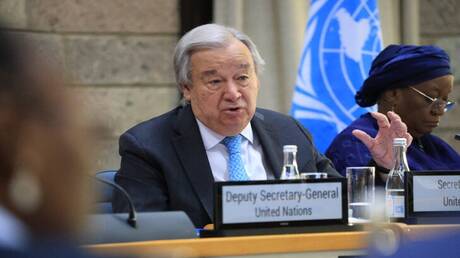
UN Secretary-General Antonio Guterres has warned that the reforms the international organization seeks to achieve will not be sufficient if member states do not commit to paying their financial dues. Guterres stated that these commitments are necessary to ensure the continuity of the UN's work and its effectiveness in addressing global challenges.
Guterres made these remarks during a press conference held in New York, where he pointed out that many member states have not fulfilled their financial obligations, negatively impacting the organization's ability to implement its programs and projects. He explained that these circumstances require urgent action from member states to settle their dues.
Details of the Event
In his remarks, Guterres noted that the UN is facing multiple crises, including humanitarian crises and armed conflicts, which require adequate financial resources. He affirmed that the ongoing reforms aim to improve the organization's efficiency, but they cannot replace financial commitments.
He also added that member states must recognize the importance of their role in supporting the UN, and that failure to meet payment obligations could undermine international efforts to address global issues. Guterres stressed that the UN needs sustainable financial support to ensure its ability to respond to increasing challenges.
Background & Context
The United Nations was established in 1945 with the goal of promoting international peace and security and providing humanitarian assistance. Over time, the organization has played a pivotal role in addressing many global issues, such as climate change, food security, and human rights.
However, the financial challenges facing the UN are not new. In recent years, the organization has witnessed a decline in funding from some member states, affecting its ability to implement its programs. Guterres pointed out that these conditions necessitate a reassessment of the financial commitments of member states.
Impact & Consequences
Guterres's statements serve as an urgent call for member states to adhere to their financial commitments. Failure to meet these obligations could lead to a reduction in UN programs, impacting millions of people who rely on humanitarian aid.
Moreover, the failure of states to pay their dues may weaken the credibility of the UN as an international organization and affect its ability to exert pressure on other member states to comply with international laws. This could lead to chaos in international relations.
Regional Significance
The Arab region is among the areas most affected by humanitarian crises and armed conflicts, making financial support for the UN vital. Many Arab countries depend on humanitarian assistance provided by the UN, and thus any reduction in funding could negatively impact the humanitarian situation in these countries.
Furthermore, financial non-compliance may affect sustainable development programs in the region, exacerbating poverty and unemployment. Therefore, Guterres's call comes at a critical time that requires Arab states to reconsider their financial commitments to the UN.
In conclusion, the financial commitment of member states remains a crucial element to ensure the continuity and effectiveness of the UN in addressing global challenges. Member states must recognize that fulfilling their financial obligations is not merely a duty but an investment in a more stable and secure future for all.