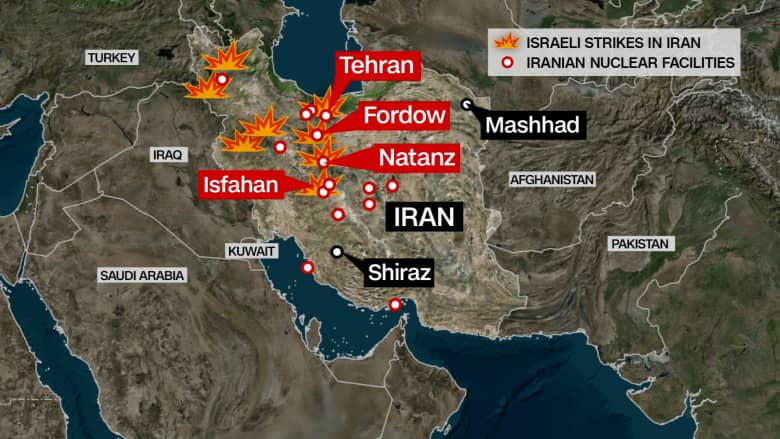
Fears are escalating that nuclear skirmishes between Iran and Israel could evolve into military actions targeting nuclear reactors, potentially leading to catastrophic consequences akin to the Chernobyl disaster. So far, these skirmishes have only involved targeting non-vital facilities, but the worst-case scenario remains a possibility, where escalation could reach the heart of nuclear reactors or less critical components.
Historically, the world has witnessed several instances of targeting nuclear facilities, but these were limited to reactors that were not operational or non-vital facilities. However, concerns about the current situation between Iran and Israel escalating into military action targeting nuclear reactors are alarming experts. Dr. Ali Abdo, a professor of nuclear physics and director of the nuclear physics department at an American energy company, confirmed that conventional military operations typically cannot damage the cores of modern reactors, such as the Iranian Bushehr reactor or the Israeli Dimona reactor.
Details of the Event
Modern nuclear reactors, such as the Russian VVER-1000, are designed to withstand collisions with commercial aircraft, making them safer. However, the danger lies in the use of bunker-busting bombs, which could reach the reactor core or less critical parts, potentially causing significant damage. A nuclear explosion, characterized by an extremely rapid reaction, can produce a fireball reaching millions of degrees, leading to widespread destruction.
Historically, nuclear disasters such as Chernobyl and Fukushima were caused by human errors or natural disasters, resulting in radioactive leaks. In the case of Chernobyl, the reactors were of a primitive type, resulting in greater environmental damage. Meanwhile, the Fukushima reactor was equipped with protective layers, reducing the damage caused by the leak.
Background & Context
Tensions between Iran and Israel have been escalating in recent years, with Israel accusing Iran of seeking to develop a military nuclear program. In contrast, Iran denies these accusations, asserting that its nuclear program is peaceful. However, any military escalation could have dire consequences for the entire region, as targeting nuclear reactors could lead to radioactive leaks threatening human health and the environment.
The protective layers in nuclear reactors include containment vessels and internal buildings designed to prevent any radioactive leaks. However, the success of either party in penetrating the reactor core using bunker-busting bombs could lead to a disaster similar to Chernobyl.
Impact & Consequences
If the worst-case scenario occurs and the reactor core is targeted, the damage would be severe. This could lead to widespread radioactive leaks, threatening human health and the environment for decades to come. Additionally, the radioactive dust resulting from the explosion could spread through the winds, increasing the scope of the impact.
In the event of targeting support or cooling systems, this could lead to overheating of the nuclear fuel, potentially causing a steam explosion and radioactive leak. Targeting spent fuel storage could also result in the release of radiation, increasing the risks.
Regional Significance
The Arab region is in dire need of avoiding any nuclear escalation, as any nuclear disaster would affect neighboring countries and lead to humanitarian and health crises. Therefore, diplomatic dialogue and regional cooperation are essential to prevent any escalation that could lead to a nuclear catastrophe.
In conclusion, hope remains pinned on diplomacy to avoid any nuclear escalation in the region. There must be joint efforts from all parties to ensure peace and security in the Middle East.