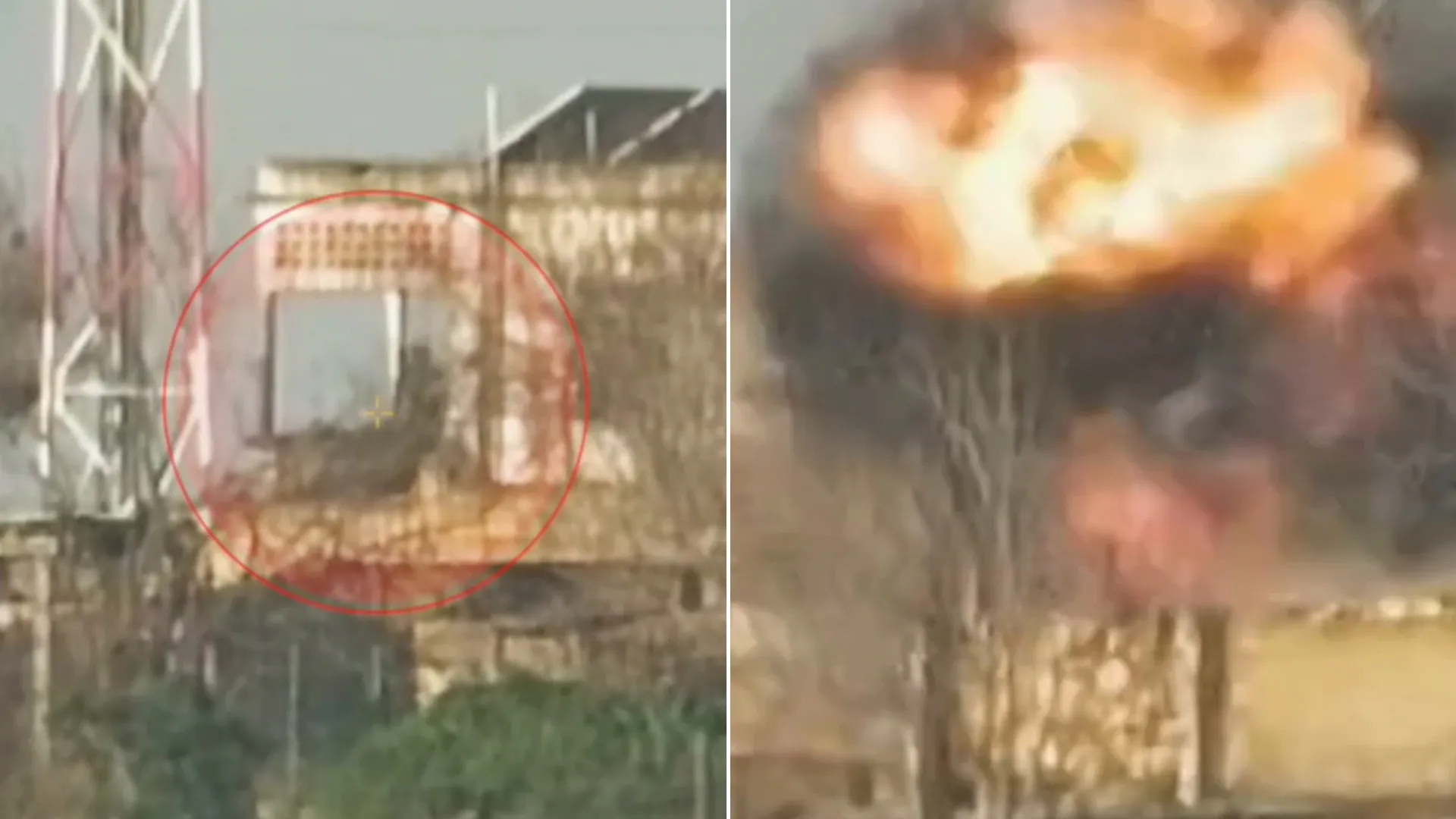
Hezbollah targeted a house sheltering Israeli occupation soldiers in a town in southern Lebanon on Sunday, March 24. The party's military media released footage documenting the operation, showcasing precise monitoring of Israeli soldiers' movements before striking the house with a guided missile, leading to a large burst of flames and smoke at the targeted location.
The attack occurred in the town of Qouzah and comes amid increasing military escalation in southern Lebanon. In this context, Hezbollah announced it had carried out attacks using missiles and drones against Israeli settlements, forces, vehicles, and military sites, a claim confirmed by the Israeli army, which acknowledged the death of one soldier and injuries to three others during the clashes in the area.
Details of the Incident
The footage released by Hezbollah's military media illustrates the accuracy of the military operations conducted by the party, as it meticulously tracked the movements of Israeli soldiers before delivering the strike. This type of operation reflects Hezbollah's strategy in confronting Israeli forces and reinforces its position as an active military power in the region.
Earlier today, a Lebanese military source informed Al Jazeera that Israeli forces had reached a tributary of the Litani River in the eastern sector, indicating an expansion of Israeli military operations in southern Lebanon. Israeli Defense Minister Israel Katz stated that the army is determined to assert control over vast areas in southern Lebanon, suggesting a potential escalation in hostilities.
Background & Context
Historically, the Lebanese-Israeli border has witnessed ongoing tensions, with Israel occupying areas in southern Lebanon for decades. The conflict between the two sides has notably escalated following the last war that occurred between October 2023 and November 2024, which led to a deterioration of security conditions in the region. Hezbollah, regarded as a resistance force, continues to assert that its operations are part of defending Lebanon and its people.
Since the beginning of March, the region has experienced an escalation in hostilities, with Israeli forces conducting airstrikes on Hezbollah positions, prompting successive reactions from the party. These dynamics indicate that the situation may trend towards further escalation, threatening the overall stability of the region.
Impact & Consequences
These military operations represent a serious escalation in the ongoing conflict, potentially leading to reciprocal reactions from both sides. The rising tensions could affect regional security and increase the likelihood of a large-scale conflict. Additionally, the continuation of mutual attacks may adversely impact the humanitarian situation in Lebanon, which is already suffering from multiple crises.
At the same time, these developments could lead to increased international support for Hezbollah, as many view it as a symbol of resistance against occupation. This support could strengthen the party's position within Lebanon, complicating the political landscape in the country.
Regional Significance
The ramifications of this conflict extend beyond the Lebanese borders, potentially affecting relations between Arab countries and Israel. The rising tensions in southern Lebanon may reflect on the situation in Palestine, possibly intensifying the conflict in the occupied territories. Furthermore, these events could impact peace efforts in the region, complicating the possibility of achieving lasting solutions.
In conclusion, the situation in southern Lebanon remains tense, with ongoing military escalation between Hezbollah and Israeli forces. These dynamics require close monitoring, as any new developments could significantly influence security and stability in the region.