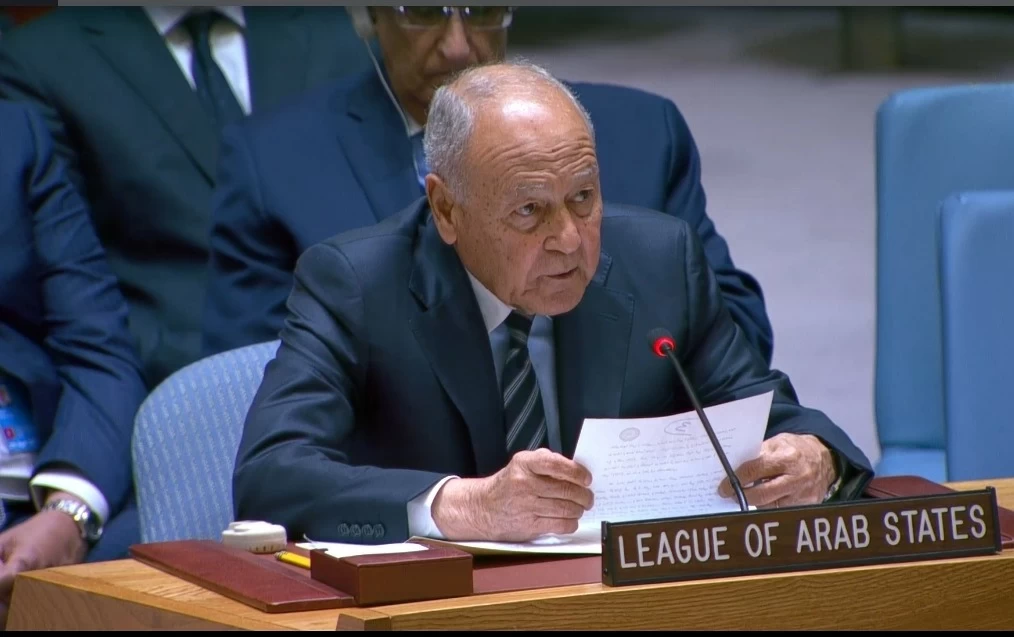
Ahmed Aboul Gheit, the Secretary-General of the Arab League, stated that the Israeli occupation of Palestine and other Arab territories is the root cause of the ongoing crises in the Middle East. This assertion was made during his speech at a Security Council discussion regarding the situation in the region, where he emphasized that Arab countries have not called for war with Iran but have sought to avoid it, despite facing unjustified Iranian aggression.
Aboul Gheit described Israeli policy as a "continuous war policy," which contributes to escalating military confrontations on multiple fronts by encroaching on territories in Gaza, Lebanon, and Syria, in addition to unprecedented settlement activities in the West Bank. He also pointed to the infringement on the territorial integrity of Somalia and the recognition of a separatist region that contradicts Security Council resolutions.
Event Details
Aboul Gheit clarified that the current Israeli government lacks a genuine vision for peace and is working to promote "ongoing conflict," which contradicts former U.S. President Donald Trump's 20-point plan aimed at reaching a settlement based on a two-state solution. Regarding the Gaza Strip, he noted that Israel treats the ceasefire reached last October as a unilateral arrangement, exacerbating the suffering of over two million Palestinians living under harsh conditions.
He also reaffirmed the Arab League's support for elements of Trump's plan related to early recovery and reconstruction, calling for its simultaneous implementation. He pointed out the failure to activate the stability force in Gaza and the non-entry of the Gaza Management Committee as stipulated in Resolution 2803, which further worsens the humanitarian situation.
Context and Background
The situation in the West Bank continues to deteriorate, with Aboul Gheit warning of an Israeli plan to effectively annex it by accelerating settlement activities, in addition to financially strangling the Palestinian Authority by withholding clearance funds since last May. These policies, he noted, turn the two-state solution into a distant dream, complicating the political and economic situations in the region.
In the Lebanese context, Aboul Gheit welcomed the U.S. President's announcement of a ceasefire, affirming the Arab League's support for the Lebanese government in regaining its sovereignty. He called for a complete Israeli withdrawal from Lebanese territories to allow displaced persons to return to their villages, stressing the importance of achieving security through justice-based peace.
Consequences and Impact
Concerns are growing that the continuation of Israeli policies may exacerbate humanitarian and political crises in the region. The absence of fair and sustainable solutions could contribute to increased tensions between Arab countries and Israel, heightening instability in the Middle East.
The humanitarian conditions in Gaza and the West Bank could lead to an outbreak of violence, necessitating urgent international intervention to achieve justice and peace. The ongoing Israeli occupation fosters a sense of frustration and despair among Palestinians, which may lead to an escalation of violence in the future.
Impact on the Arab Region
This situation poses a significant challenge for Arab countries, requiring them to take clear stances regarding Israeli policies. Supporting the Palestinian cause must be a priority, especially given the difficult circumstances faced by Palestinians.
In conclusion, Aboul Gheit asserted that "the illusion that military power alone achieves security is merely a delusion," emphasizing that security comes from peace based on justice. He called on the Security Council to play an active role in achieving justice and peace in the region, which requires collective efforts from all concerned parties.