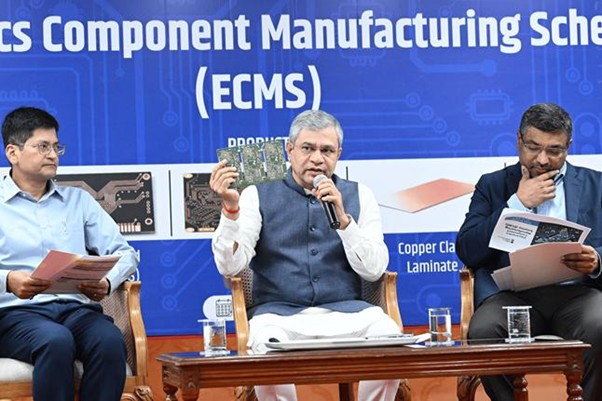
In a strategic move aimed at enhancing the local manufacturing sector, the Indian government approved 29 projects from various companies under the electronics manufacturing program on Monday, with a total investment reaching ₹71.04 billion (approximately $751.21 million), as announced by the Ministry of Electronics and Information Technology.
This initiative is part of a series of incentive programs launched by the government to attract both local and international investors, increase local production capacity, reduce reliance on imports, and strengthen supply chains, as part of its efforts to improve the electronics manufacturing sector in the country.
Details of the Approved Projects
The approved projects encompass multiple fields such as mobile phone manufacturing, telecommunications, consumer electronics, automotive products, and devices. Among the projects that received approval, a unit from Dixon Technologies was greenlit to manufacture display units, while Lohum Cleantech received approval to produce permanent magnets from rare earth elements, marking the first project of its kind in India.
The Indian government aims to increase the electronics sector's production, which generated revenues of $125 billion in the fiscal year ending March 2025, to $500 billion by the fiscal year 2031.
Background & Context
Historically, India has witnessed significant growth in the electronics sector, becoming one of the largest global markets. However, the country has heavily relied on imports to meet its electronic component needs. In recent years, the Indian government has recognized the importance of boosting local production, leading to the launch of various incentive programs such as the Production Linked Incentive scheme aimed at supporting local and international companies.
This step is part of the Indian government's vision to become a global hub for electronics manufacturing, especially with the increasing demand for electronic devices in the global market.
Impact & Consequences
These projects are expected to contribute to economic growth in India, creating new job opportunities and enhancing the country's competitiveness in the global market. Furthermore, this initiative may attract more foreign investments, particularly from major companies like Apple and Samsung, which are looking for opportunities to expand their operations in India.
Moreover, boosting local production of electronic components will help India reduce its reliance on imports, thereby enhancing the stability of the national economy and mitigating risks associated with fluctuations in the global market.
Regional Significance
These developments in India are particularly significant for the Arab region, as they could lead to new cooperation opportunities in technology and manufacturing. Arab countries may benefit from India's experiences in enhancing local production, especially given the economic challenges they face.
Additionally, strengthening trade relations between India and Arab countries in the electronics sector could open new avenues for cooperation and investment, fostering economic growth on both sides.