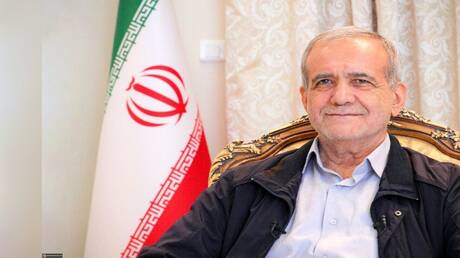
In a message directed at the American people, Iranian President Masoud Bezhakian asserted that Iranian attacks are framed as a 'right to self-defense,' emphasizing that there is no hostility towards American citizens. These remarks come at a time when relations between Iran and the United States are increasingly strained, raising questions about the political and security dimensions of these statements.
Bezhakian, who assumed office during a sensitive period in Iran's history, noted that his country acts in accordance with principles of international law, and that the attacks carried out are responses to what he perceives as threats from other parties. He affirmed that Iran does not harbor animosity towards American citizens, but seeks to protect its national interests.
Details of the Incident
Bezhakian's statements come amid rising military tensions in the region, where recent months have witnessed a series of reciprocal attacks between Iran and American forces in Iraq and Syria. Tehran has deemed these attacks as reactions to what it describes as the United States' hostile policies towards it.
Bezhakian also pointed out that Iran adopts a defensive policy aimed at safeguarding its sovereignty, and that it does not seek to escalate tensions with the United States. This message arrives at a critical moment, as major powers continue their discussions regarding the Iranian nuclear agreement, which remains a central issue in Tehran-Washington relations.
Background & Context
The roots of tension between Iran and the United States date back decades, with relations deteriorating significantly since the Iranian Revolution in 1979. Since then, the United States has imposed economic sanctions on Iran, which have severely impacted its economy and exacerbated social and political conditions within the country.
In recent years, tensions have intensified following the United States' withdrawal from the nuclear agreement in 2018, prompting Iran to gradually reduce its nuclear commitments. This has heightened fears of a potential direct military confrontation between the two parties.
Impact & Consequences
Bezhakian's statements serve as a clear message to the international community, as Iran seeks to clarify its position regarding the attacks it conducts. While this statement may help ease tensions, it could also escalate positions if not handled cautiously by the involved parties.
Moreover, these remarks could influence the course of negotiations regarding the nuclear agreement, as Iran aims to portray itself as a sovereign state acting in accordance with its national interests, potentially complicating efforts to reach a comprehensive agreement that ensures regional stability.
Regional Significance
The tensions between Iran and the United States directly impact security and stability in the Arab region. Ongoing conflicts in Iraq, Syria, and Lebanon, which involve Iranian-backed parties, pose significant challenges to neighboring Arab states.
Furthermore, Iranian statements may affect relations between Iran and Arab countries, as some of these nations seek to enhance cooperation with the United States in countering Iranian threats. Thus, any escalation in tensions could exacerbate security conditions in the region and heighten political divisions.
In conclusion, Iranian-American relations remain a focal point of international interest, as the current situation demands serious dialogue and cooperation among the involved parties to avoid any escalation that could lead to dire consequences for regional and international security.