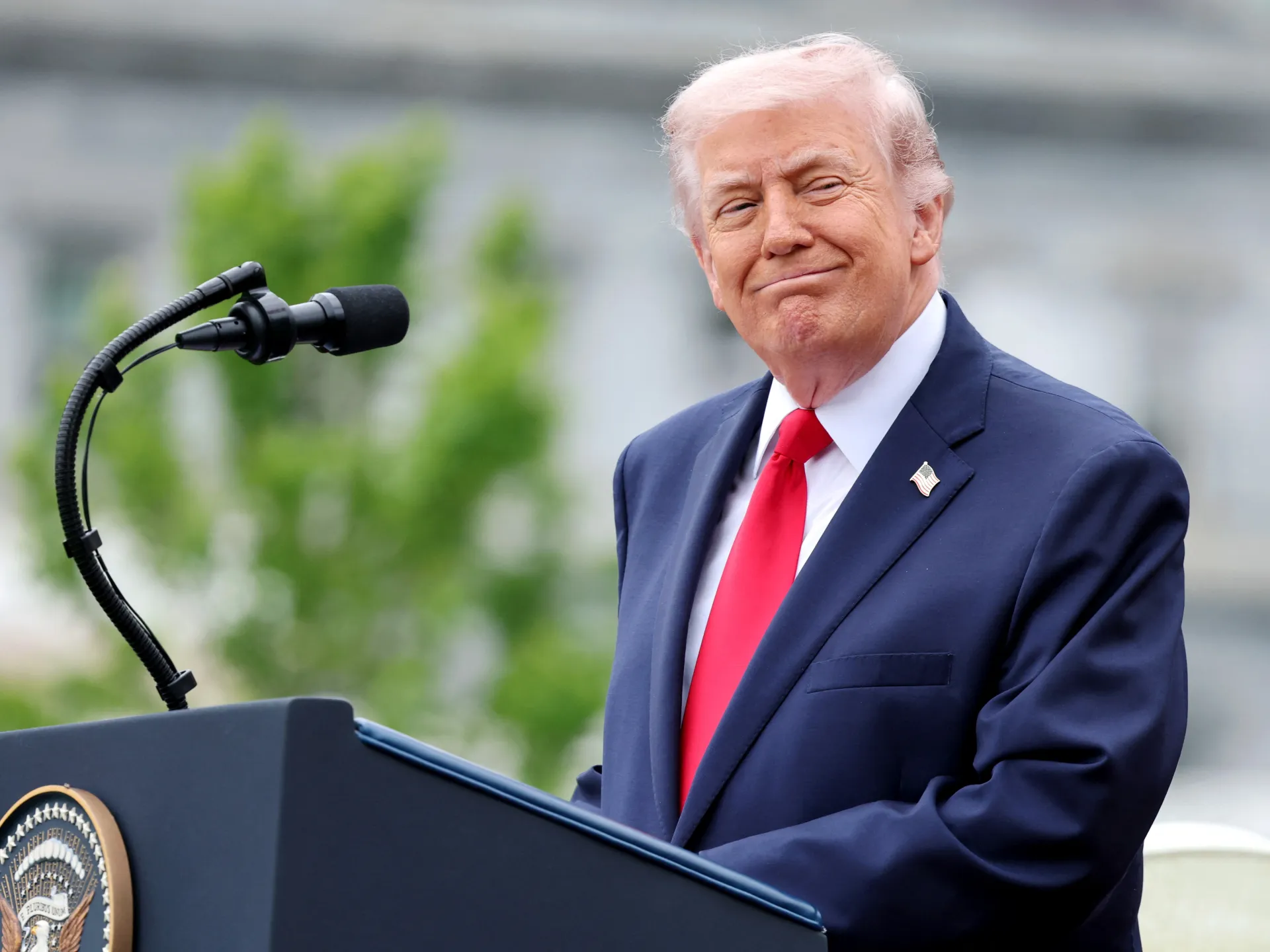
In a new development regarding U.S.-Iranian relations, President Donald Trump disclosed an Iranian proposal concerning the opening of the Strait of Hormuz in exchange for lifting the blockade imposed on Iranian ports. These statements followed a meeting of the National Security Council at the White House, where Trump did not firmly state his position but merely presented what was proposed by Tehran.
In this context, Al Jazeera's correspondent in Washington, Ahmad Al-Ruhid, noted that the statements reflect the current U.S. administration's approach, which is carefully considering its options without making a final decision yet. The United States has deemed the blockade an effective pressure tool, with Trump describing it as "yielding ideal results," making any retreat conditional on significant gains, such as Iran abandoning enrichment and handing over its stockpile of enriched uranium.
Details of the Proposal
The Al Jazeera bureau chief in Tehran, Nour El-Din Al-Dughair, clarified that Iran is awaiting the U.S. response to the proposal conveyed through a Pakistani intermediary, in preparation for entering a new round of negotiations. Al-Dughair indicated that Tehran seeks to separate the issues at hand, considering the cessation of war a priority, which opens the door to the opening of the Strait of Hormuz and lifting the blockade.
Al-Dughair also reported that Iran is attempting to frame its position legally, having informed the United Nations and the Security Council that it is not a party to the 1982 convention governing straits, which makes it not bound by its provisions. Tehran believes that tightening its grip on the strait is driven by security and economic reasons, as the strait is a vital point for transporting arms and funding for reconstruction.
Context and Background
Amid these developments, Emad Abshenas, a political science professor at the University of Tehran, confirmed that his country did not make a direct proposal to the United States, but rather this came as part of a Pakistani mediation aimed at organizing negotiation priorities. Abshenas explained that Iran presented its offer to the Pakistani side, while Washington has yet to provide its perspective.
Abshenas also described the U.S. statements regarding Iran's request to open the Strait of Hormuz as "lies," noting that he has communicated with officials and intermediaries and has not confirmed the existence of any message to that effect. He viewed these statements as part of an American attempt to escape a political impasse, denying any Iranian proposal demanding the opening of the strait in this manner.
Consequences and Impact
Abshenas clarified that the Iranian proposal is based on the priority of stopping the war and hostilities in the region, indicating that the Strait of Hormuz issue falls within this package, alongside lifting the blockade and halting military operations. He emphasized that Tehran sees the necessity of addressing these issues sequentially, with the cessation of war coming first, followed by other matters such as the nuclear file.
He also criticized the American proposal, considering that the conditions set, such as dismantling the nuclear and missile programs, represent Israeli demands, stressing that Tehran will not accept them. He pointed out that Iran's position has changed after the recent war, as Tehran is no longer willing to make the concessions that were previously on the table.
Impact on the Arab Region
Concerns are growing that these developments may lead to renewed escalation in the region, as the ongoing tension reflects a lack of a clear path to settlement. These negotiations could impact regional stability, especially amid repeated American threats.
In conclusion, it seems that the coming days will be decisive in determining the course of U.S.-Iranian relations, as Tehran awaits the outcome of American positions amidst an atmosphere of uncertainty and ongoing tension.